


![[PRE ORDER] MHW-3BOMBER Cube Coffee Scale 3.0 Mini Pro](http://coffeeplus.in/cdn/shop/files/MHW-3BOMBERCubeCoffeeScale2.0MiniCoffeePlus5.webp?v=1768422727&width=500)

![[PRE ORDER] TIMEMORE Black Mirror Basic 3.0](http://coffeeplus.in/cdn/shop/files/TIMEMOREBlackMirrorBasic3.0_1.webp?v=1769444750&width=500)


![[PRE ORDER] MHW-3BOMBER Cube Coffee Scale 3.0 Pro](http://coffeeplus.in/cdn/shop/files/MHW-3BOMBERCubeCoffeeScale3.0Pro2.webp?v=1777319705&width=500)


![[PRE ORDER] Espressa Orbit 64 PRO | MOKKOM Grinder](http://coffeeplus.in/cdn/shop/files/Espressa_Orbit_Pro_2.webp?v=1779828190&width=500)


![[PRE ORDER] MHW-3BOMBER X-Press58](http://coffeeplus.in/cdn/shop/files/X-press58.webp?v=1763141665&width=500)


![[PRE ORDER] MHW-3BOMBER Cyclone Needle Distribution Tool 58mm](http://coffeeplus.in/cdn/shop/files/CycloneNeedleDistributor.webp?v=1762881161&width=500)




How to Audit Your Espresso Bar for Wasted Time and Lost Revenue: A Workflow Guide for Indian Café Operators (2026)
Most café operators know their service feels slow during a rush but cannot identify where exactly the time disappears. The answer is almost never the espresso machine — it is the 8–12 seconds lost between each step in the workflow that nobody has ever timed. A structured time-motion audit of your espresso bar can recover 15–20 seconds per drink without buying new equipment, which at 80 drinks per day translates to 20–27 minutes of daily output capacity returned to your service window.
A café owner in Chandigarh was convinced she needed a second espresso machine to handle weekend service. The queue was long, the team was stressed, and drinks were taking 4–5 minutes from order to handoff. She had been researching espresso machine prices for cafés in India and was preparing to invest in a second 2-group unit. Before the purchase, we ran a simple time-motion audit of her bar during a Saturday service. The machine was pulling shots in 28 seconds. The grinder was dispensing in 12 seconds. Everything mechanical was performing correctly. The time was disappearing in the spaces between steps: the barista walking 6 steps to the knock box, turning around to reach the tamper on the opposite counter edge, moving back to the grinder, and then crossing to the steam wand that was positioned away from the group head. Twenty-two seconds of walking per drink. Eighty drinks on a Saturday: 29 minutes of movement that produced nothing. The fix was a counter reorganisation and three workflow tools. No second machine was needed.
Why Workflow Bottlenecks Feel Like Equipment Problems
When service is slow, the natural instinct is to look at the machine. It is the largest, most expensive, most visible piece of equipment on the bar — and when it becomes the focal point of frustration, it attracts the blame regardless of whether it is actually the constraint.
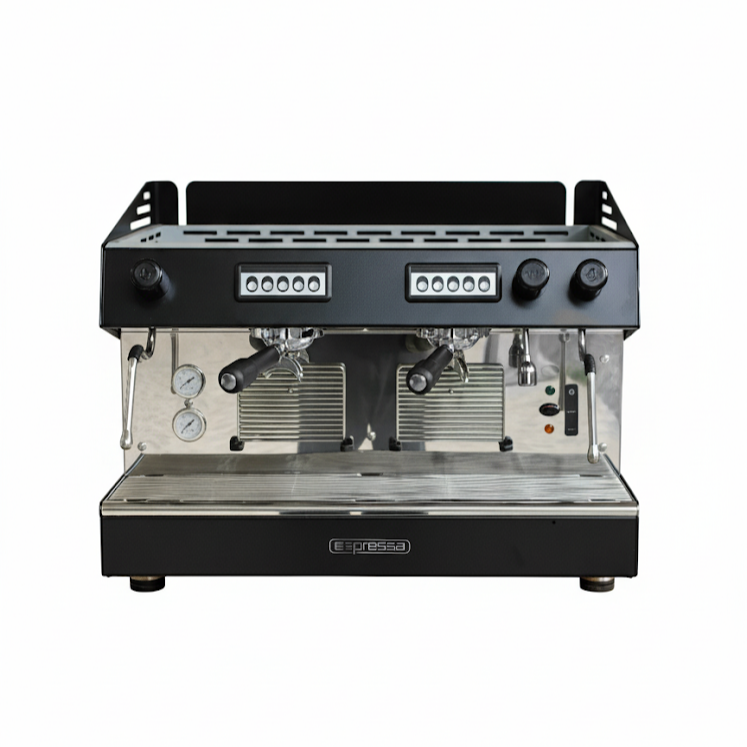
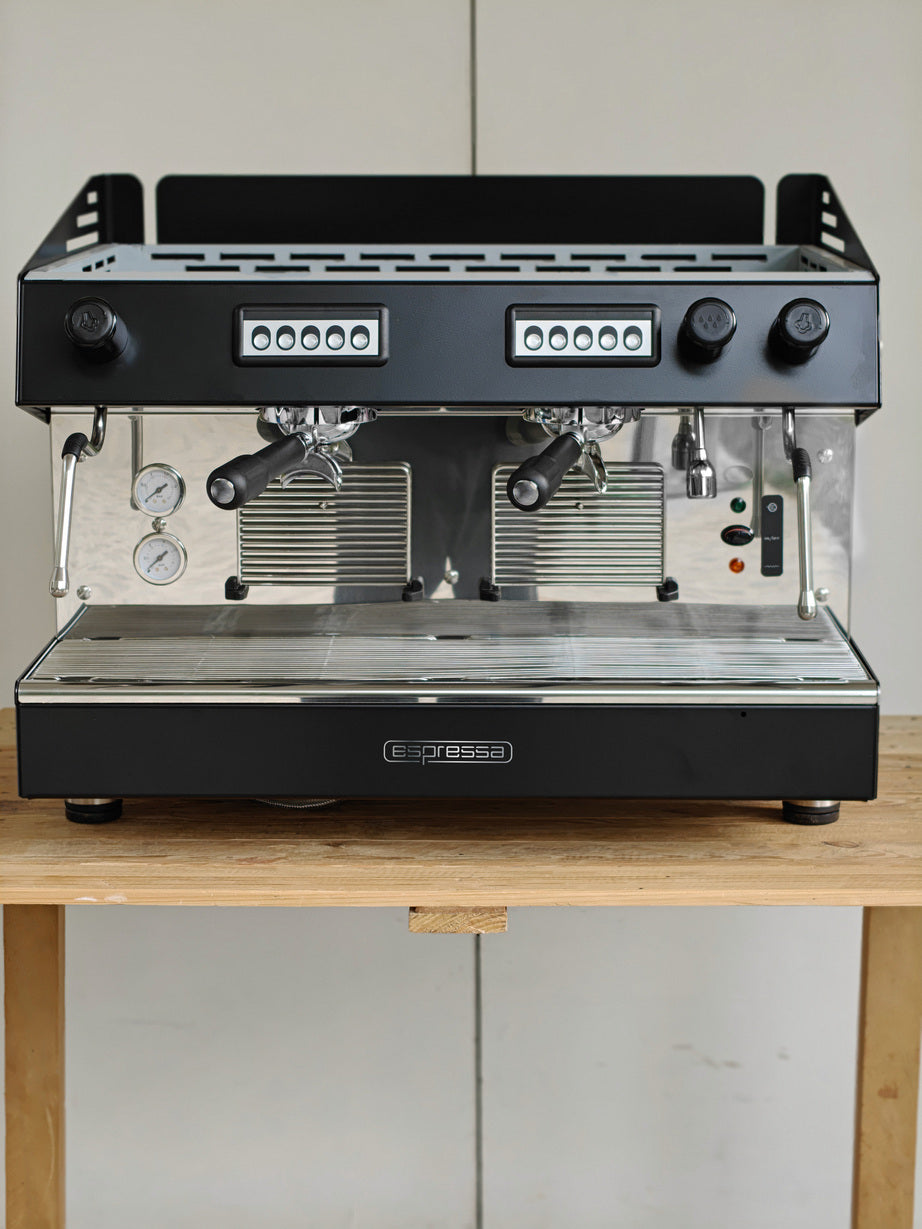
The reality in most busy Indian café kitchens is that the machine is rarely the bottleneck. A commercial 2-group machine — whether a Casadio Nettuno, an Espressa Falcon, or an Izensso Raptor — can produce drinks faster than a well-staffed bar can dispatch them when the workflow around it is efficient. The bottleneck is almost always in the human workflow: unnecessary movement, unergonomic station layout, missing tools that force workarounds, and sequential task execution where parallel execution is possible.
Identifying the actual bottleneck requires a structured audit, not intuition.
Step 1: Time Each Workflow Step From Grind to Handoff
The audit begins with a stopwatch and someone willing to observe and record without participating in service. Time every distinct step in the drink-making sequence separately. Do not time the complete drink — time each component in isolation.
The standard commercial espresso drink workflow breaks into these discrete steps:
-
Knock and clean portafilter: From locking out to clean, dry basket ready
-
Grind and dose: From pressing grind button to portafilter loaded with correct dose
-
Distribute and tamp: From loaded portafilter to tamped, levelled, ready to lock
-
Lock in and start extraction: From reaching the group head to shot running
-
Shot extraction: 25–30 seconds — this is machine-determined and largely fixed
-
Milk steaming: From pitcher to steamed milk ready (for milk drinks)
-
Assembly and handoff: Pouring, cup placement, passing to customer
Record the actual time for each step across 10–15 consecutive drinks during a real service session. Do not observe during warm-up or slow periods. Capture peak service behaviour because that is where the real numbers live.
What you are looking for is not the total time — it is the ratio of productive time to movement time. Any second spent walking, reaching across the body, or waiting for something to be in the right position is a second that is not making coffee.
Step 2: Measure Barista Movement Distance Per Drink
After timing each step, observe and estimate the physical distance the barista travels per complete drink cycle. This sounds unusual but it is one of the highest-yield metrics in a bar audit.
A well-designed espresso bar station requires no more than one pivot step between the grinder, the group head, the tamping station, and the steam wand. Everything should be reachable within 60–70cm of the barista's primary standing position. If the barista is taking 3–6 steps per drink cycle, the station layout is costing time on every single drink, compounded across the service day.
Common movement waste in Indian café bars:
-
Knock box positioned away from the group head, requiring the barista to walk away and return
-
Tamper stored in a drawer or on a shelf rather than on the tamping mat at hand position
-
Scales not at the tamping station, requiring barista to carry the portafilter to a separate point
-
Steam wand on the opposite side of the machine from the barista's primary working position
-
Milk pitchers stored in a fridge that requires a separate movement to access during service
Each of these costs 3–8 seconds per drink. At 100 drinks per day, the combined effect of three such inefficiencies is 15–40 minutes of daily output capacity absorbed by movement.
Step 3: Identify the Specific Bottleneck Operation
After timing and movement data are collected, one step will consistently show a disproportionate time cost. This is the bottleneck — the operation that, if improved, recovers the most time per drink.
The most common bottlenecks found in Indian commercial bars:
Tamping inconsistency causing re-dos: When baristas are manually tamping without a calibrated tamper or tamping station, they occasionally retamp, check the level, or redo the distribution. Each re-do adds 5–10 seconds and is invisible until you are timing the step. An automatic tamper — which delivers consistent pressure and level tamp in a single press — eliminates the re-do variable entirely and reduces the distribute-and-tamp step to under 5 seconds from the typical 12–18 seconds of manual tamping with occasional correction.
Grinder retention causing dose checks: Grinders with high coffee retention between doses require the barista to knock or shake the grinder body to dislodge retained grounds before the next dose is consistent. On a Ceado E7 with its near-zero retention design, the dose dispensed is consistent from button press to button press without intervention. On older grinders or designs with significant retention, this workaround adds 4–7 seconds per dose.
Milk pitcher management: Cafés without a designated milk staging area — cold pitchers pre-staged at the steam wand before service begins — create a mid-drink movement to the fridge every time a new pitcher is needed. Staging 4–5 cold pitchers at the steam station before service eliminates this movement entirely.
Cup staging distance: If cups require the barista to turn away from the machine to collect them, cup staging is a bottleneck. Cups should be within arm reach of the group head — warmed and stacked in order of size at the machine's side.
Step 4: Calculate the Revenue Impact of Each Bottleneck
Once bottlenecks are identified and timed, the revenue calculation is straightforward.
Take your average drink time improvement — for example, recovering 15 seconds per drink — and calculate what that returns at your daily volume and average ticket value.
At 100 drinks per day, 15 seconds recovered per drink returns 25 minutes of daily service capacity. If your peak service window is 3 hours and your bar is currently constrained to 33 drinks per hour, recovering 25 minutes of capacity adds the ability to serve 13–14 additional drinks during peak. At an average ticket of ₹150–₹200, that is ₹2,000–₹2,800 of additional daily revenue potential from workflow improvements alone — without a single equipment upgrade.
Over a month, that is ₹60,000–₹84,000 of recoverable revenue sitting in a reorganised counter and three workflow tools. It is the highest ROI intervention available to most café operators, and it costs almost nothing to implement.
Step 5: The Workflow Redesigns That Recover the Most Time
Based on audit data from Indian café operations, these are the specific changes that consistently recover the most time per drink:
Consolidate the tamping station to the machine's immediate left or right. Tamping mat, calibrated tamper, dosing funnel, and scale — all within 30cm of the group head. The barista should not move their feet between grinding, distributing, tamping, and locking in.
Install the knock box directly below the group head or at the grinder position. Not on a separate counter section, not in a drawer, not across the bar. The commercial knock box from the Espressa accessories range is designed with a counter-mount footprint that positions the knock bar immediately accessible from the group head without a step away.
Use a grinder with automatic weight-based dosing. The Ceado E7 with its programmable weight-based dispensing eliminates the check-and-adjust dosing habit that adds 3–5 seconds per drink on timer-based grinders. The dose is dispensed to target weight — the barista receives a consistent dose on every press without verification.
Pre-stage milk before service, not during. Four pitchers, pre-filled to your standard volumes, stationed at the steam wand before the first customer order. This eliminates the fridge movement that breaks the milk-parallel workflow during back-to-back drink sequences.
Parallel steam and extraction. On a dual boiler machine — where the steam boiler and brew boiler operate independently — a skilled barista can start steaming milk while the shot is extracting, reducing the effective drink cycle time for milk drinks by 25–30 seconds compared to sequential execution. Machines like the Espressa Falcon and Izensso Raptor are designed for this parallel workflow because their independent thermal systems do not require the barista to wait for the machine to switch between brewing and steaming modes.
Audit Results Summary: What a Typical Indian Café Bar Recovers
Mistakes to Avoid: The Audit Assumption That Wastes the Fix
Mistake: Running the audit during a slow period and drawing conclusions that do not apply to peak service.
Workflow inefficiencies are often invisible at low volume. At 3 drinks in 10 minutes, a barista moving 6 steps between each task looks relaxed and unhurried. At 12 drinks in 10 minutes, the same movement pattern creates a visible queue, a stressed barista, and inconsistent execution. The audit must be run during the actual peak window — the busiest 45 minutes of your day — because that is the only environment where bottlenecks become constraints. Auditing at 10am on a Tuesday tells you nothing about what is limiting your Saturday 11am–12pm service.
Run the audit during peak service, on multiple days, with different team members — because some bottlenecks are barista-specific habits and some are station design issues, and you need to distinguish between the two before deciding where to spend time and money on fixes.
At Coffee.Plus, workflow audits are part of the consultation we offer to commercial operators — whether you are setting up a new bar with espresso machine installation and training in India or optimising an existing operation that is not performing to its potential. Every machine and grinder we supply, from the Espressa ES.One to the Ceado E7 with pan-India technician support, is specified with your specific workflow in mind — not just the cup count on a spec sheet. AMC visits include workflow assessments alongside preventive maintenance because equipment performance and bar design work together. If you would like to understand what an efficient commercial bar layout looks like with your shortlisted machines in the space, our Experience Centre in Delhi at 14 Regency, Asola is designed for exactly that kind of operational planning conversation.