









Group Head Technologies Explained for Indian Cafés: Thermosyphon, Saturated, and Multi-Boiler (2026 Guide)
The group head is the single most consequential component in any commercial espresso machine — it is the interface between your boiler's thermal energy and the coffee puck, and its design architecture determines how stable your extraction temperature is across consecutive shots during a busy service. Most Indian café operators choose machines based on brand or price without understanding that the group head technology is what separates consistent quality across 80 shots from quality that holds for the first 20 and drifts through the rest. This guide explains the three dominant group head architectures in clear, practical terms and tells you which one belongs in your operation.
A café owner in Dehradun had been pulling consistently excellent espresso during morning calibration — every shot clean, sweet, and within his target 28-second window. By Saturday afternoon with a full 40-seat service in progress, shots were noticeably different. Faster, thinner, slightly bitter. He assumed it was the grinder drifting from heat. He adjusted. Shots improved briefly, then drifted again. Two weeks of chasing the afternoon grind problem before a technician visit revealed the actual issue: the machine's thermosyphon group head was operating 3–4°C above its calibrated temperature during sustained high-volume service because the thermosyphon circulation rate had increased with the heat load. The machine's boiler was running hotter under sustained demand, and the group head was faithfully delivering that elevated temperature to the puck. The problem was not the grinder. It was group head architecture running above its designed stable range under Indian summer service conditions.
What a Group Head Actually Does and Why Architecture Matters
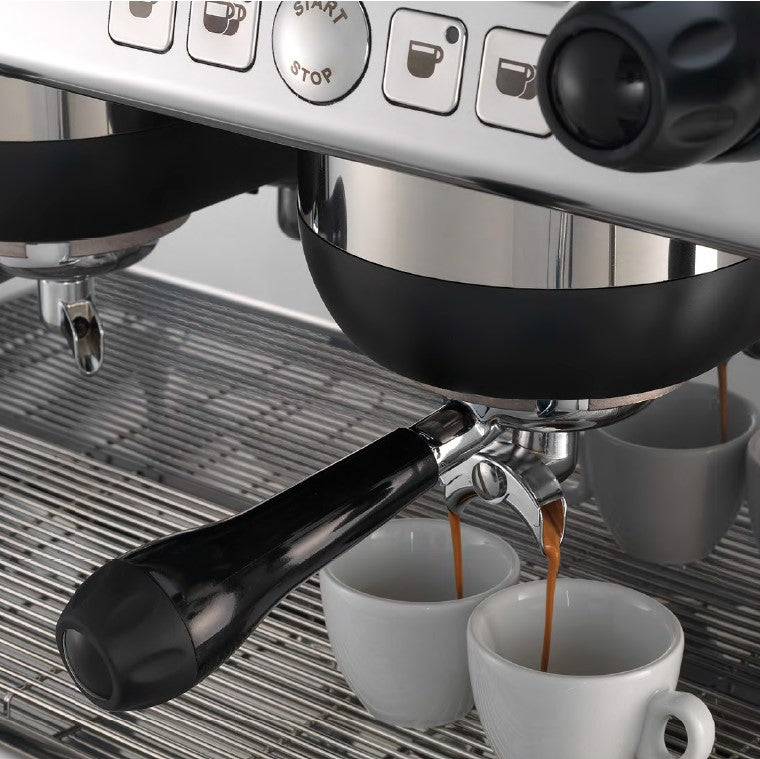
The group head is the assembly on the front of the espresso machine where the portafilter locks in and pressurised hot water is delivered to the coffee puck. Its job sounds simple: hold the portafilter and deliver water at the correct temperature and pressure. The engineering challenge is that this needs to happen consistently across the first shot of the morning and the 80th shot of a Saturday afternoon, through varying ambient temperatures, back-to-back milk drink cycles, and the thermal demands of simultaneous multi-group extraction.
The group head receives its thermal energy from the machine's boiler. How it manages, distributes, and stabilises that energy across the extraction cycle is entirely determined by its design architecture. Three architectures dominate commercial espresso machines available in India's commercial café market: thermosyphon, saturated, and multi-boiler with independent group boilers. Each makes a specific set of engineering tradeoffs that determine where the machine performs well and where it has limits.
Thermosyphon Group Heads: The Commercial Standard and Its Limits
The thermosyphon is the most widely used group head architecture in commercial espresso machines globally. It is the design found in the majority of Italian commercial machines at mid-commercial price points and represents a mature, well-understood technology with genuine strengths and specific limitations.
How it works: A thermosyphon system heats the group head through passive convective circulation of hot water from the boiler. Hot water rises through a feed pipe into the group head, releases heat to the metal mass of the group head body, cools slightly, and returns to the boiler through a return pipe. This creates a continuous circulation loop that keeps the group head at a temperature close to the boiler's set point without any active pumping.
The business benefit at moderate volume: A well-designed thermosyphon group head heats up quickly, maintains stable temperature through moderate consecutive use, and requires minimal active management. For a commercial espresso machine for a small café in India running 40–70 cups per day across a 2–3 hour peak window, thermosyphon architecture delivers reliable, consistent results without the engineering complexity or price premium of more sophisticated systems.
The limitation at high volume and high ambient temperature: The thermosyphon's temperature stability is dependent on the boiler maintaining a consistent temperature. Under sustained high-volume extraction — 10–15 consecutive shots in a 20-minute window — the boiler temperature fluctuates as it responds to continuous heat demand. The group head temperature follows the boiler variation with a slight lag. In European café conditions at 20–22°C ambient, this variation is typically within ±1°C — acceptable for commercial operation. In an Indian café kitchen at 34–38°C summer ambient temperature, the thermosyphon's circulation rate increases with ambient heat input, and boiler temperature variance under peak load can translate to group head temperature variance of ±2–3°C — wide enough to produce noticeably different extractions at the same grind setting across the service window.
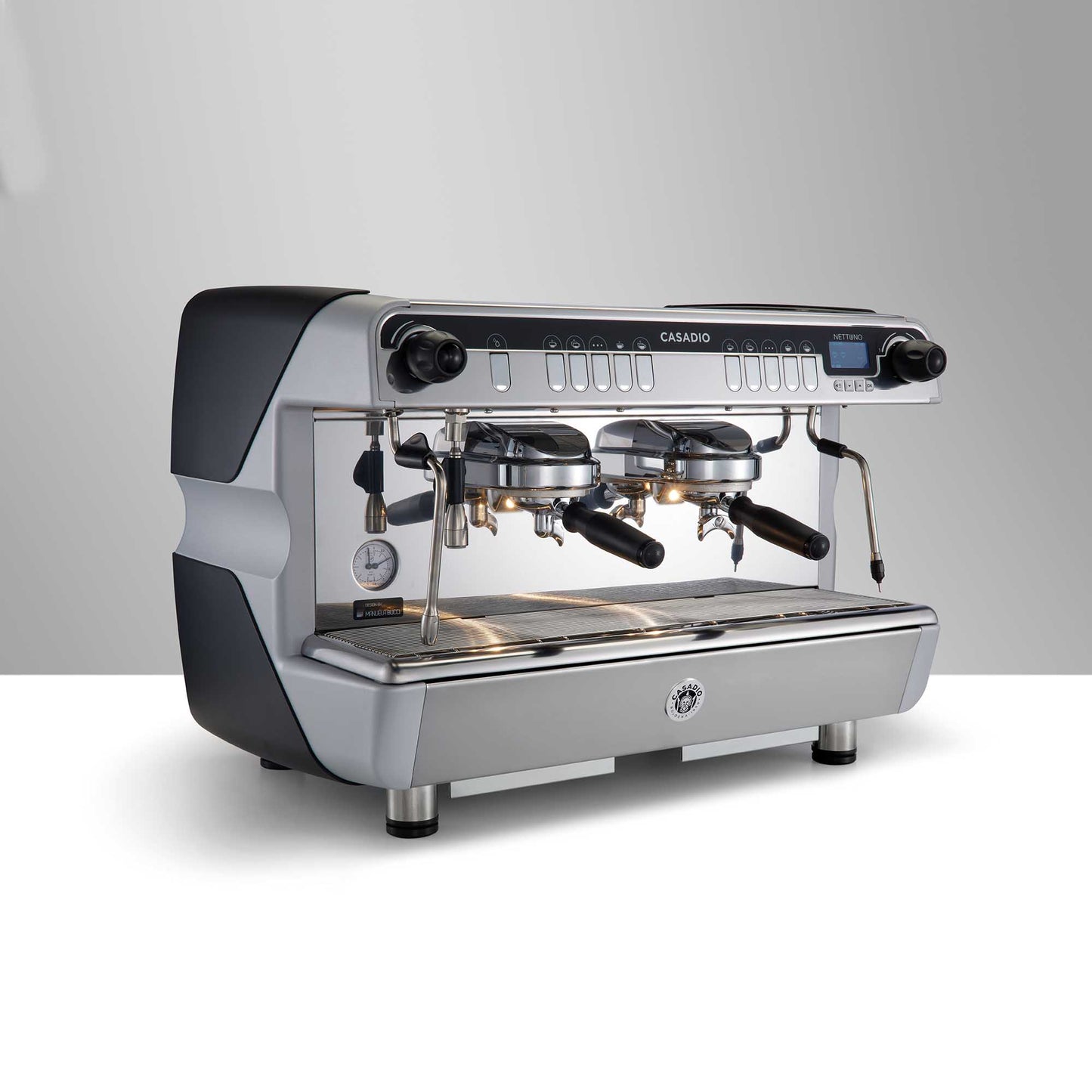
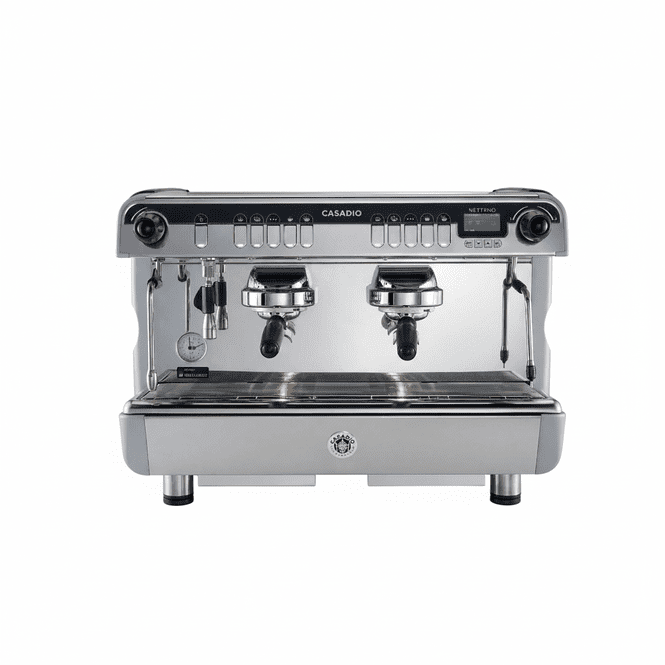
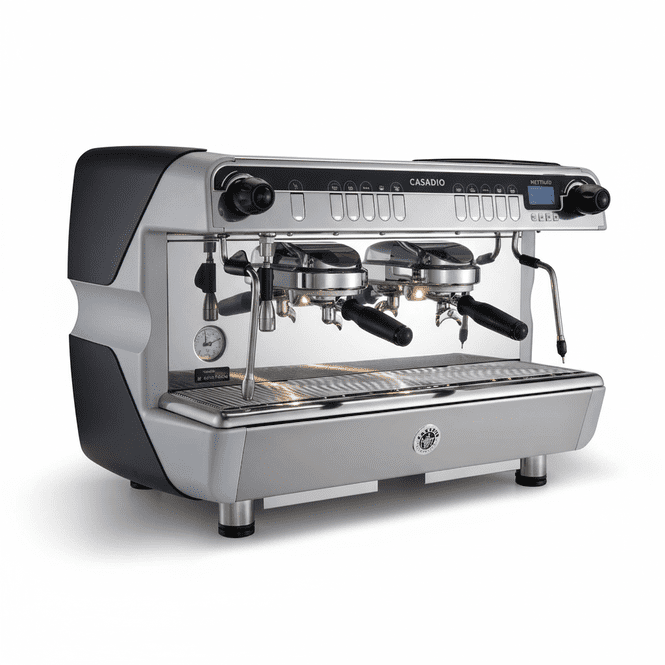
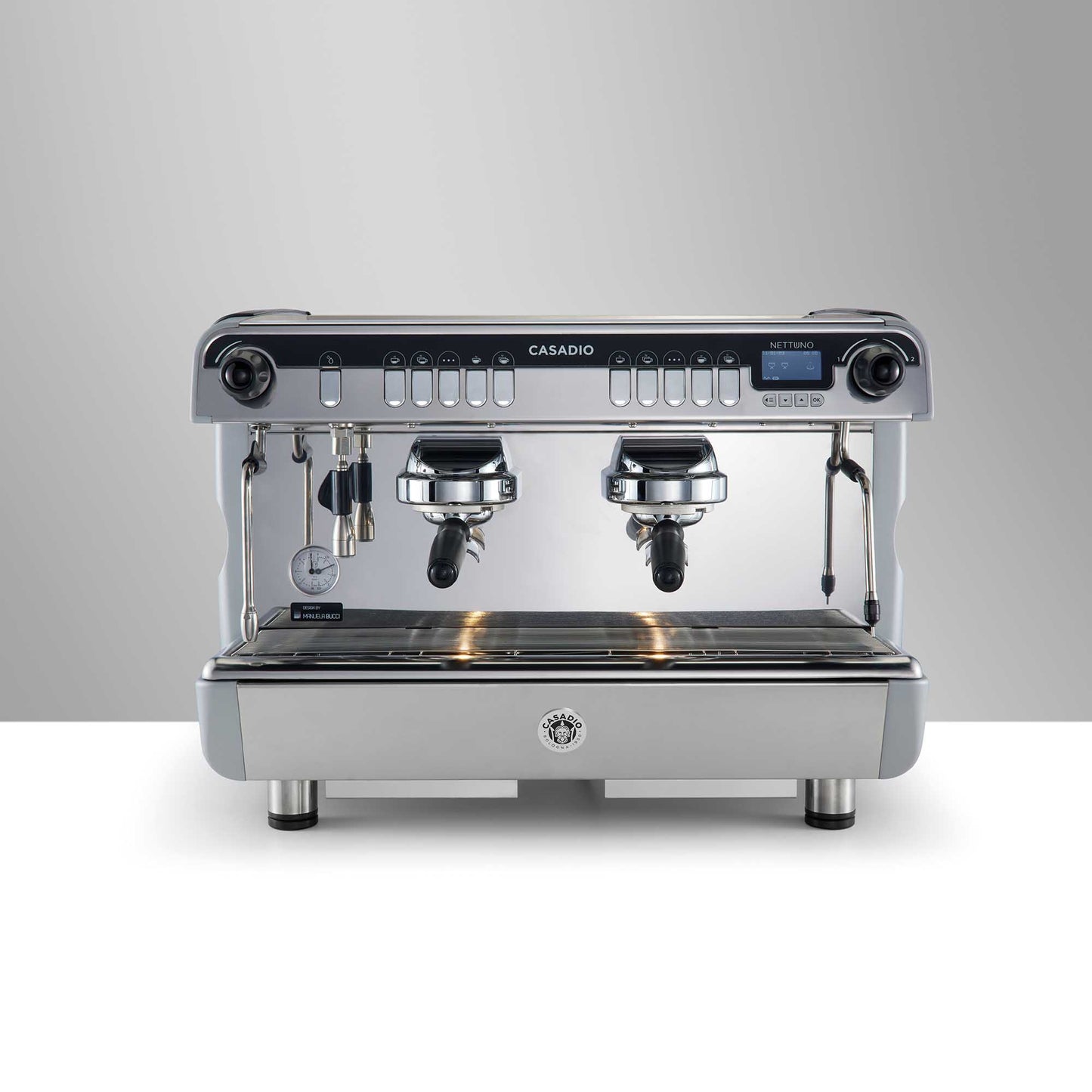
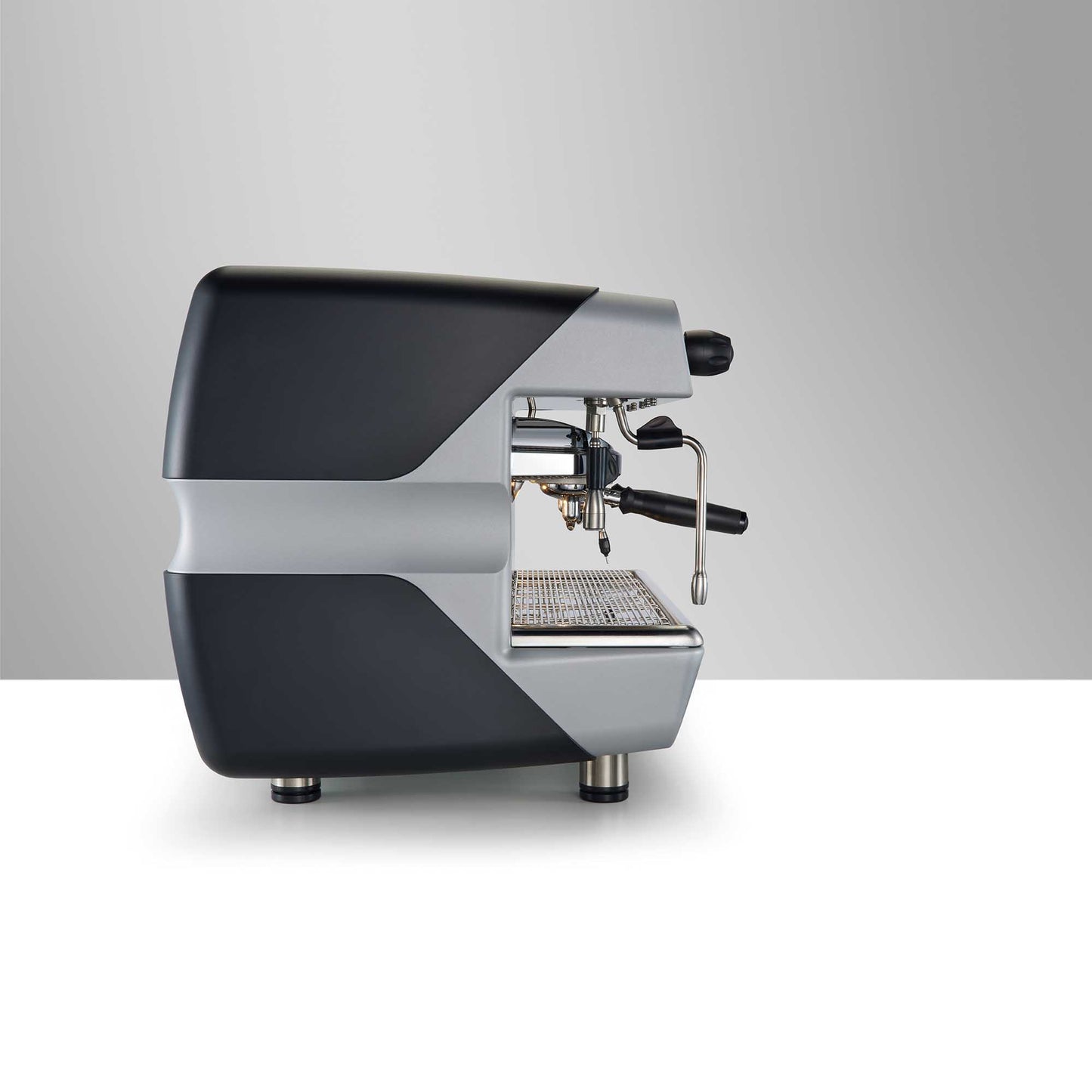
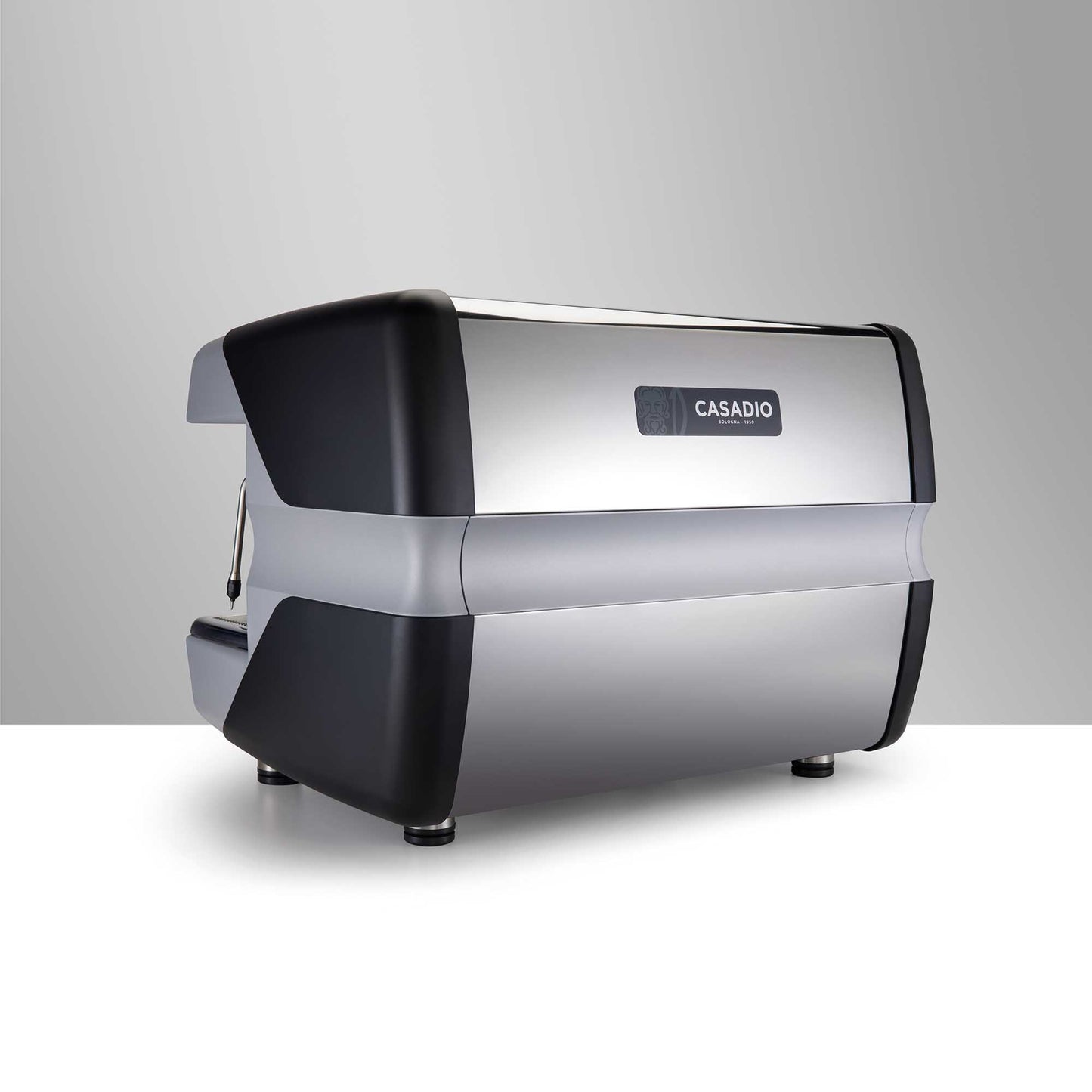
The Espressa ES.One uses a commercial thermosyphon group head engineered with additional thermal mass at the group body — a design approach that buffers the temperature variance inherent to thermosyphon circulation by absorbing and smoothing short-term boiler fluctuations. For a 1-group commercial operation with controlled daily volume, this architecture performs reliably. The Casadio Nettuno in 2-group configuration similarly delivers consistent thermosyphon performance at moderate volume for operators where espresso machine price for café in India is the primary decision constraint.
Saturated Group Heads: Thermal Stability Through Immersion
The saturated group head — also called the saturated design or E61 saturated in its most widely known form — takes a different approach to temperature stability. Rather than circulating water through a passage in the group head body, the saturated design submerges the group head mechanism directly in the boiler water.
How it works: In a saturated group head design, the entire group head casting is in direct thermal contact with the boiler water, which surrounds and saturates the group head body. There is no separate circulation circuit — the group head IS part of the boiler thermal mass. Water fills the group head from the top and sits in contact with the heating element indirectly through the boiler walls.
The business benefit: Because the group head is thermally saturated by direct contact with the boiler water, its temperature responds immediately and uniformly to the boiler's set point. There is no thermosyphon circulation lag, no ambient-temperature-sensitive variation in circulation rate, and no separate circuit whose flow rate can change under different operating conditions. For operations where temperature accuracy and repeatability matter — specialty single-origin espresso, light roast menus, or any café where the extraction window is narrow — the saturated design delivers more consistent group head temperature across consecutive shots than a thermosyphon at comparable volume.
The limitation: A saturated group head is architecturally tied to a single boiler. If the boiler is serving both brew and steam functions — as in a single-boiler or heat-exchanger machine — the saturated group head experiences temperature variance when the boiler is called to increase temperature for steam generation. The benefit of the saturated design is most fully realised in a dedicated brew boiler configuration, which leads directly to the third and most capable architecture.
Multi-Boiler with Independent Group Boilers: The Architecture for High-Volume and Specialty Use
The multi-boiler architecture — where each group head has its own independent dedicated boiler, entirely separate from the steam boiler — represents the highest level of thermal control available in commercial espresso machines. It is the architecture that defines premium commercial machines and is increasingly relevant for Indian cafés serious about both specialty coffee quality and high-volume consistent output.
How it works: Each group head is fed by its own small dedicated boiler, controlled by its own independent PID controller. The steam boiler is a separate, larger dedicated boiler with its own PID. These systems operate entirely independently — what happens thermally at the steam wand has zero effect on the brew temperature at any group head. Each group's temperature is set, maintained, and monitored independently.
The business benefit — consistency under simultaneous load: This is the architecture's primary commercial value. When two baristas are pulling shots simultaneously on both groups while a third milk drink is being steamed, the multi-boiler machine's thermal stability is unaffected by any of these concurrent demands. Each group maintains its programmed temperature to within ±0.1–0.3°C regardless of what the other circuits are doing. For the best espresso machine for a 50-seat café in India where simultaneous extraction and steaming during peak service is the daily operational reality, this level of thermal independence is not a luxury — it is the engineering condition that makes quality consistency possible.
The business benefit — per-group temperature programming: Independent group boilers allow different temperatures to be set on different groups on the same machine. A café running both a commercial blend on one group and a light single-origin on another can set group 1 at 93°C and group 2 at 95°C simultaneously. This multi-origin workflow is commercially relevant for the growing number of Indian specialty cafés — from Bengaluru to Delhi to Pune — that run mixed menus combining approachable milk-forward offerings with a showcase specialty extraction.
The Izensso Raptor with its T3 multi-boiler system brings independent group boiler architecture to the mid-commercial price tier — making it the dual boiler espresso machine for a café in India that operators at the 80–150 cup daily volume range can access without the premium price point of European multi-boiler flagships. Each group on the Raptor maintains its set temperature through sustained simultaneous service, giving high-milk-volume Indian café bars the extraction consistency that thermosyphon machines cannot guarantee during rush hours.
The Espressa Base Multiboiler and Espressa Falcon bring this same architectural principle — dedicated, independent brew boiler management — to operators at different volume and budget tiers. The Falcon's thermomatic system provides per-group temperature control with programmable pre-infusion sequences, making it the mid-commercial choice for specialty-focused operations running multiple bean profiles on the same 2-group machine.
At the precision end of the commercial spectrum, the Dalla Corte Mina and Studio represent multi-boiler architecture at its most refined. Per-group independent boilers with Digital Flow Regulation (DFR) provide not just temperature stability but active real-time flow and pressure control per group, per shot. This is the architecture for roastery cafés, hotel F&B programs, and specialty showcase operations where the machine's precision is the enabling condition for the coffee's full expression — commercial coffee equipment for hotels and offices running high-expectations specialty programmes.
Temperature Stability Across Group Head Architectures: A Practical Comparison
Choosing the Right Group Head Architecture for Your Indian Café
The decision between group head architectures is not about which technology is objectively superior — it is about which architecture's performance envelope matches your operational profile and coffee menu.
If your menu is 70–80% milk-based drinks, you run dark to medium commercial blends, and your daily volume is under 80 cups: A well-specified thermosyphon machine — commercial espresso machine for small café in India pricing, rotary pump, high thermal mass group — performs reliably and represents sound capital allocation. The temperature variance that thermosyphon shows at high volume is not a material quality issue at 70 cups per day on a forgiving dark blend.
If your menu includes specialty single-origins, light roasts, or you run more than 80 cups per day with a milk-forward high-speed service: Multi-boiler architecture is the correct specification. The extraction temperature stability that independent group boilers deliver is the engineering condition your coffee and your volume require. Espresso machine installation and training in India for multi-boiler machines covers the per-group temperature programming that makes this architecture's advantages operational rather than theoretical.
If you are operating commercial coffee equipment for hotels and offices where all-day volume, simultaneous multi-drink orders, and consistency across multiple staff are all requirements simultaneously: Multi-boiler with dedicated steam capacity — the Izensso Raptor or Dalla Corte range — is the architecture that matches the operational demands of institutional hospitality coffee.
Mistakes to Avoid: Choosing Architecture Based on Price Without Considering Volume and Temperature Requirements
Mistake: Selecting a thermosyphon machine for a high-volume specialty operation because the price point is attractive, then discovering during summer peak service that group head temperature variance is undermining extraction consistency in ways the morning calibration never revealed.
This is the group head architecture mistake that costs the most — not in repair bills but in quality compromise that is invisible at purchase time and fully apparent under real operating conditions. The Dehradun café owner's story at the start of this piece is this mistake in practice. The solution is to specify group head architecture against your peak operating conditions — highest volume, hottest kitchen ambient, most demanding coffee on the menu — not against your average quiet-day performance.
At Coffee.Plus, group head architecture is one of the first conversations in any commercial machine consultation, alongside daily volume, menu profile, and kitchen ambient conditions. Whether you are evaluating a dual boiler espresso machine for café in India at the Izensso Raptor tier, the Espressa Falcon's thermomatic architecture, or a Dalla Corte multi-boiler for a premium operation — every recommendation accounts for your specific extraction temperature requirements across peak service, not just on a quiet calibration morning. Every machine supplied comes with espresso machine installation and training in India that covers per-group temperature setup and verification, so the architecture advantage is realised from day one. Pan-India technician support ensures group head performance is assessed at every AMC visit with pressure and temperature logging against your machine's programmed targets. Visit our Experience Centre in Delhi at 14 Regency, Asola to run back-to-back peak service simulations on machines across all three architecture types — the temperature difference across 20 consecutive shots is something you need to experience before committing your capital, not read about after the fact.