






The better question in the stainless steel vs copper espresso boiler debate is not “Which material wins?” but “Which complete machine design suits my water, workload and service plan?” Copper offers very high thermal conductivity, while stainless steel offers strong corrosion resistance; neither material alone determines durability, temperature stability or maintenance cost.
A copper boiler can fail early if water chemistry and maintenance are poorly managed. A stainless boiler can also develop scale, corrosion or service problems if its design, water treatment and cleaning regime are wrong. For a café, evaluate the espresso boiler materials, heating design, water treatment, spare-parts access and technician support as one system.
What Does a Boiler Actually Do?
An espresso machine must supply water at brew temperature for extraction and at a much higher temperature for steam. Coffee Plus’s guide to single boiler, heat exchanger and dual boiler machines explains that brew water is typically managed around 90–96°C, while steam systems operate far hotter inside the boiler.
The boiler’s job is therefore not simply to “get hot.” It must:
-
Heat water efficiently
-
Recover after continuous extraction and steaming
-
Maintain a stable temperature at the group
-
Resist scale and corrosion under local water conditions
-
Allow safe inspection, descaling and repair
Material is one input into that system. It is not the whole answer.
Copper vs Stainless Steel: What Each Material Does
| Factor | Copper boiler | Stainless steel boiler |
|---|---|---|
| Thermal conductivity | Very high; transfers heat readily | Lower than copper; requires a heating and control design suited to it |
| Heat response | Can respond quickly to heat input | May need a different heater, boiler shape or control strategy |
| Corrosion resistance | Can corrode under unsuitable water chemistry | Generally corrosion-resistant, but not corrosion-proof |
| Scale behaviour | Can form scale; requires compatible water and maintenance | Can still form scale; material does not prevent deposits |
| Water treatment | Requires disciplined, manufacturer-compatible treatment | Still requires correct treatment and approved cleaning |
| Repair approach | Depends on boiler construction, access and parts availability | Depends on construction, access and parts availability |
| Best interpretation | A thermally efficient material choice | A corrosion-resistant material choice |
Copper has historically been used in boilers because it conducts heat very effectively; Barista Hustle cites copper’s thermal conductivity at more than 400 W/mK compared with about 14 W/mK for stainless steel. That is a genuine engineering advantage, but it does not automatically translate into better espresso if the rest of the machine is poorly designed.
Stainless steel is generally more corrosion-resistant, but it is not immune to scale or corrosion. Its performance depends on alloy, surface condition, water chemistry and the surrounding environment.
Does Copper Mean Better Temperature Stability?
No. Copper can transfer heat efficiently, but temperature stability is a system outcome.
A machine’s stability depends on:
-
Boiler size and thermal mass
-
Heating element power and placement
-
PID or mechanical control logic
-
Group head architecture
-
Recovery rate during simultaneous brewing and steaming
-
Ambient kitchen temperature
-
Incoming water temperature
-
Flush routine, where applicable
A well-designed stainless boiler machine can hold temperature more consistently than a poorly designed copper machine. Conversely, a copper boiler can be excellent when the heater, controller, group and maintenance plan are properly matched.
Coffee.Plus’s group head guide shows why this matters: under sustained peak load, group temperature behaviour can vary materially between thermosyphon, heat-exchanger and multi-boiler architectures, regardless of boiler material alone.
Does Stainless Steel Mean No Maintenance?
No. Stainless steel is corrosion-resistant, not maintenance-free.
It can still accumulate mineral scale, especially where incoming water is hard. Scale reduces heat-transfer efficiency, can restrict passages and may affect temperature response. The material may tolerate certain cleaning approaches better than copper, but that does not justify ignoring water treatment or using aggressive chemicals.
A stainless boiler still needs:
-
Manufacturer-approved water treatment
-
Correct filtration or softening where appropriate
-
Scheduled inspection
-
Approved descaling only when appropriate for the machine
-
Regular group and steam-wand cleaning
-
Service access for valves, probes, gaskets and heating components
Coffee Plus’s espresso machine cleaning routine for Indian cafés sets out why daily, weekly and periodic maintenance matter, including manufacturer-approved descaling in hard-water areas. The useful claim is not “stainless steel needs no descaling.” The useful claim is that it may offer more tolerance to certain water conditions, provided the complete machine design supports it.
Is Copper More Likely to Corrode?
Copper can corrode, but material name alone does not predict failure.
Corrosion risk depends on water chemistry, including hardness, pH, dissolved minerals, chlorides and treatment method. A copper boiler in a machine with unsuitable water, poor filtration or incorrect chemical use may be more vulnerable than a stainless boiler in a properly managed system.
For Indian cafés, the practical question is especially important because municipal supply quality, borewell water, TDS, hardness and seasonal variation can differ sharply by location. A machine that performs well in one city may need a different water-management plan in another.
Ask the supplier:
-
What water specification does the manufacturer recommend?
-
Does the machine require filtration, softening, remineralisation or a specific blend?
-
What is the approved descaling procedure?
-
Which components are technician-serviceable?
-
Are boiler probes, valves, gaskets and heating elements readily available?
-
What does the service plan include?
Which Questions Should a Café Ask Before Buying?
Instead of asking “Is copper or stainless steel better?”, ask these questions:
| Better question | Why it matters |
|---|---|
| What is my café’s peak-hour brew and steam demand? | Determines whether a single boiler, HX or multi-boiler architecture is appropriate |
| What is my incoming water profile? | Determines filtration, treatment and maintenance requirements |
| How does the machine manage brew and steam temperatures? | Reveals whether material choice is supported by good thermal design |
| How accessible are service points? | Affects downtime and repair cost |
| What is the approved descaling process? | Prevents damage from incorrect chemicals or procedures |
| Are spare parts available for the specific model? | Protects long-term serviceability |
| What warranty and service support apply? | Clarifies what happens if a boiler-related fault occurs |
| Has the machine been specified for my water conditions? | Avoids treating a generic setup as universally suitable |
How Should Water Be Managed?
Water is the main variable that connects boiler material to real-world reliability.
Do not assume that:
-
Copper always requires more descaling
-
Stainless steel never scales
-
Softened water is automatically suitable
-
Distilled or untreated reverse-osmosis water is always safe
-
More filtration is always better
The correct approach is to match the machine manufacturer’s water specification to the café’s incoming water. In some cases, that may mean filtration; in others, controlled softening, remineralisation or a specific treatment blend.
Avoid switching to pure distilled or unmodified reverse-osmosis water without manufacturer guidance. Water that is too low in minerals can create its own corrosion and extraction problems, while overly hard water increases scale risk.
What Should a Service Inspection Cover?
A boiler-related service inspection should assess the complete water path, not only the visible material.
Ask a technician to check:
-
Boiler pressure and temperature against the machine’s settings
-
Heating element condition and electrical safety
-
Pressure relief and safety valve operation
-
Probe and sensor accuracy
-
Scale accumulation where accessible
-
Valve, gasket and fitting condition
-
Group temperature stability during consecutive shots
-
Steam performance and recovery
-
Water treatment system condition
-
Any unusual taste, discolouration or pressure behaviour
Do not open a pressurised boiler, bypass safety valves or attempt aggressive internal cleaning. Follow the machine-specific manual and use a qualified technician for internal boiler work.
Common Mistakes When Comparing Boiler Materials
Treating material as a durability guarantee
Durability depends on water treatment, maintenance, operating conditions and component quality—not the metal name alone.
Assuming copper is obsolete
Copper remains a legitimate engineering choice where thermal design, water management and service support are appropriate.
Assuming stainless steel eliminates scale
Stainless steel resists corrosion better than many materials, but it can still develop scale and require maintenance.
Choosing a machine without checking water
A high-specification machine can still suffer avoidable problems if the café’s water treatment is unsuitable.
Comparing boilers without considering architecture
A copper heat-exchanger machine and a stainless multi-boiler machine are not directly comparable on material alone. Their workflows, temperature control and service requirements differ.
Ignoring service access
A machine that is difficult to service can become expensive even if its boiler material is technically sound.
Which Machine Should a Café Choose?
Choose based on the operating requirement:
| Café requirement | Better evaluation focus |
|---|---|
| Low volume, slow bar | Simple, serviceable machine with correct water management |
| Milk-heavy menu | Adequate steam capacity, recovery and workflow |
| Specialty espresso | Stable brew temperature and group architecture |
| High peak volume | Boiler recovery, multi-boiler capability and service support |
| Hard or variable water | Manufacturer-approved water treatment and accessible maintenance |
| Long-term ownership | Parts availability, technician access and preventive maintenance |
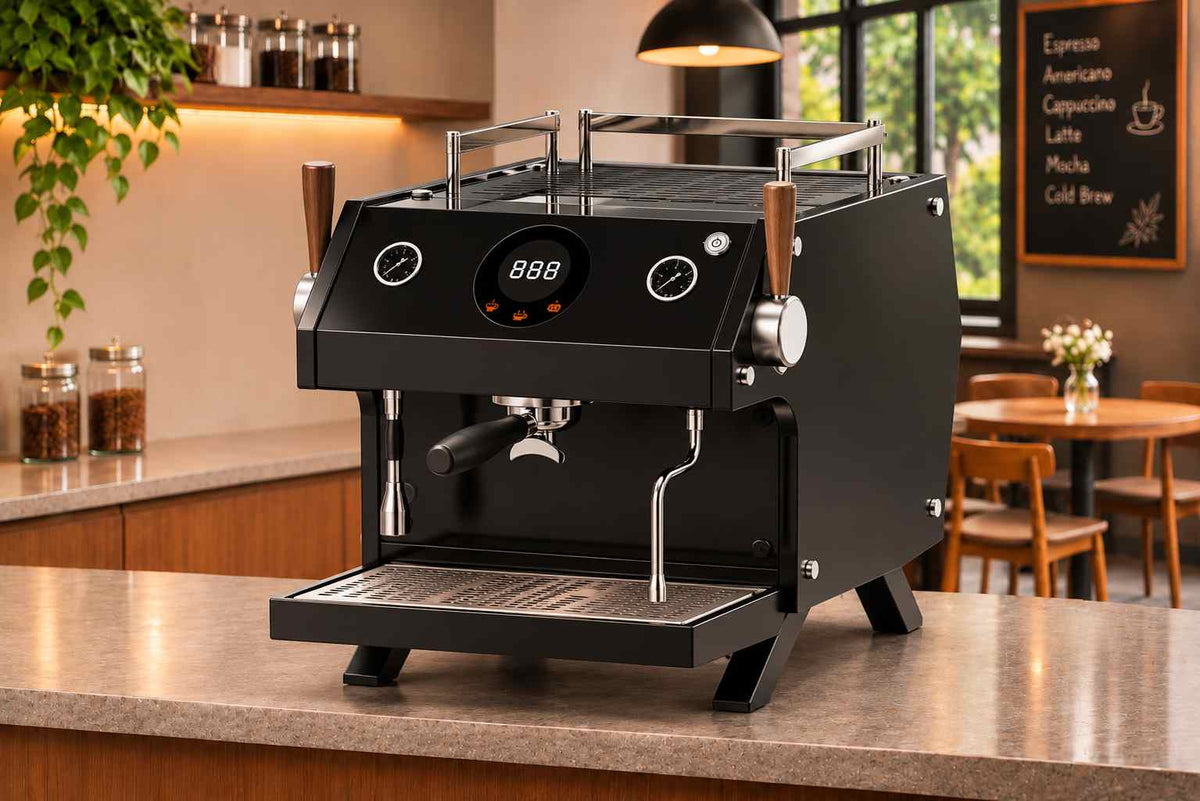
The Espressa Base Multiboiler is relevant for a café evaluating a milk-heavy menu. Its listed configuration includes a 10-litre steam boiler and two independent 0.8-litre brew boilers, with adjustable group temperatures and pre-infusion. That architecture is more relevant to real-world stability than boiler material alone.coffeeplus
The Espressa Falcon Multiboiler is a higher-output comparison point. Its listed specification includes an 11-litre steam boiler, two 1-litre brew boilers, independent PID control and 58mm saturated group heads. It requires a dedicated 220–240V, 32-amp electrical connection, so electrical planning is part of the decision, not an afterthought.
For the coffee side of the equation, the Flair coffee beans product page is relevant when testing how a machine’s temperature behaviour affects a specific coffee. A boiler that is stable for one roast may still need recipe adjustment for another, so the machine and coffee should be evaluated together.
FAQs
Is copper better than stainless steel for espresso boilers?
Neither is universally better. Copper conducts heat more readily, while stainless steel is generally more corrosion-resistant. The better machine depends on the complete design, water conditions and service plan.
Does stainless steel prevent limescale?
No. Stainless steel can still develop scale. It may offer more tolerance in some water conditions, but it still needs appropriate treatment and maintenance.
Are copper boilers harder to maintain?
They can require disciplined water management and model-specific maintenance, but maintenance difficulty depends on the machine design, access and approved procedures, not copper alone.
Does boiler material affect espresso taste?
It can influence temperature behaviour and water contact, but taste is also shaped by coffee, grind, dose, water chemistry, group temperature and machine cleanliness. Material alone does not determine flavour.
Should I choose a copper or stainless boiler for an Indian café?
Start with your peak-hour volume, milk demand, water profile and service access. Then compare complete machines that meet those requirements, rather than selecting by boiler material first.
Choose the System, Not the Metal
Stainless steel vs copper espresso boiler is a useful technical comparison only when it leads to better questions about water, heat management, group architecture and serviceability. The strongest commercial choice is the machine whose complete design matches the café’s water conditions, workload and maintenance reality.
Coffee Plus can help cafés compare boiler architecture, water requirements, machine capacity and service considerations before purchase. The most useful next step is to review the café’s busiest service window and incoming water profile, then evaluate machines that are specified for those conditions rather than choosing by material name alone.