








Pairing the Right Ceado Grinder with Your Espresso Machine Volume and Menu in India (2026)
The right Ceado grinder is not the most expensive one — it is the one that matches your shot count, roast style, and bar workflow without becoming the bottleneck. For Indian cafés comparing espresso machine price for cafe in India, grinder pairing is what determines whether the bar feels smooth at 40 shots a day or still stable at 150 shots a day.
A common mistake is to buy a strong commercial espresso machine and treat the grinder as a secondary purchase. That works until the first busy Saturday, when the machine is ready but the grinder cannot keep up, or the grind drifts as the burrs heat up. In practice, the grinder is often the hidden reason a café feels slow, inconsistent, or hard to train. That is why operators asking for a commercial espresso machine for small cafe in India should be asking the same volume question about the grinder.
Why Grinder Matching Matters More Than Most Buyers Think
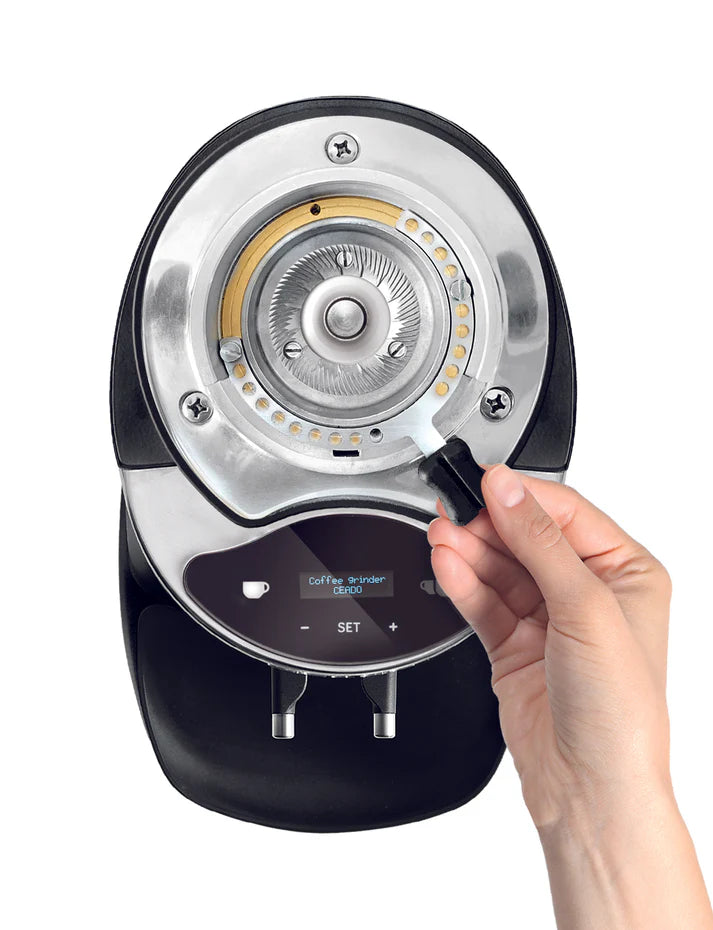
The grinder controls particle size, distribution, and dose consistency, which directly affect extraction time, crema stability, and flavour balance. If the grinder is too small for the café’s output, the burrs heat up and the grind can drift during peak service. If it is too large for the menu and volume, the café may spend more than necessary without getting a meaningful workflow benefit.
For Indian cafés, the decision should start with three variables: daily drink count, roast style, and menu complexity. A light roast menu needs a grinder that holds calibration well under stress. A milk-heavy menu needs speed and repeatability. A café with multiple beans on rotation benefits from low retention and easier changeovers. That is why Ceado’s commercial range is useful: the line covers starting commercial models, mid-volume workhorses, and high-output grinders with different levels of automation.
Choosing By Daily Volume
Under 50 drinks a day
If your café or kiosk is under 50 drinks a day, you do not need a large commercial grinder with heavy automation. A compact model such as the Ceado Leon 800, available with Coffee.Plus pan-India technician support, is often enough because it gives stable grind quality without overcomplicating the bar. It is a good fit when the menu is simple, the team is small, and the espresso machine is also a compact model like an Espressa Nimbus Pro, available with Coffee.Plus pan-India technician support.
At this level, the business benefit is simplicity. You want easy dial-in, low noise, and enough thermal stability to keep the first shot and the fiftieth shot close together. A commercial espresso machine for small cafe in India paired with a manageable grinder is usually the best operational choice.
50 to 100 drinks a day
This is the zone where many cafés begin to outgrow entry-level grinders. If your volume is steady through the day and your menu includes milk drinks, doubles, and the occasional single-origin espresso, the grinder needs to be faster and more stable. The Ceado E7, available with Coffee.Plus pan-India technician support, is a strong fit here because its 64mm flat burrs and Steady Lock system help maintain grind consistency through a real service window rather than just a calibration shot.
This is the range where many buyers ask for the best espresso machine for 50 seat cafe India, but the better question is whether the grinder can maintain pace with the machine. A 2-group or dual boiler espresso machine for cafe India setup only works well if the grinder can feed it without lag or heat drift. At this tier, the grinder is no longer just a tool — it is a throughput asset.
100 to 150 drinks a day
Once the café enters high-volume territory, burr size and motor power become more important. Larger burrs usually mean higher output and less heat buildup per shot. More motor power means the grinder can sustain service without sounding strained or slowing down at the wrong moment. For this range, the Ceado REV Steel, available with Coffee.Plus pan-India technician support, is the kind of grinder that starts making sense because it brings 83mm burrs, weight-based dosing, and stronger thermal control to a busy bar.
This is where commercial coffee equipment for hotels & offices also starts to overlap with café requirements. The grinder must be able to serve repeated espresso orders, large milk-drink demand, and minimal staff intervention. If you are running a best espresso machine for 50 seat cafe India style layout but expect heavy breakfast or evening spikes, a high-output grinder is not optional.
What Ceado Technologies Change In Daily Service
Steady Lock
Ceado’s Steady Lock system keeps the burr distance stable even under working stress. That means the grind does not shift as the machine heats up or the bar gets busier. The business value is shot consistency: the first drink of the morning and the last drink before closing stay much closer together.
This matters most when your café serves light roasts or has staff rotation. A new barista can produce more reliable results when the grinder is not moving under load.
Burr size
Ceado’s commercial range uses burr sizes from 64mm to 83mm depending on model. Smaller burrs are easier to manage at lower volumes and fit compact counters better. Larger burrs support higher throughput and cooler grinding during peak service.
In practical terms, 64mm burrs are right for modest output and controlled menus, while 83mm burrs are the better choice when the café needs speed, consistency, and more output per hour. This is one reason the Ceado E37R, available with Coffee.Plus pan-India technician support, and the Ceado REV Zero WAM, also available with Coffee.Plus pan-India technician support, are suited to different commercial realities even though both sit in the premium Ceado family.
Motor power
Motor power matters because it affects how comfortably the grinder handles continuous use. A weaker motor may still be fine for low-volume service, but it can become noisy or uneven at peak. A stronger motor helps the grinder stay calm under load, which improves bar rhythm and reduces the likelihood of grind drift.
For cafés using a dual boiler espresso machine for cafe India where steam and extraction happen in parallel, a grinder with stronger motor capacity keeps the entire workflow smoother. The grinder should not become the bottleneck when the machine is ready.
Matching Grinder To Menu Style
If you are selecting a machine and grinder together, this chart should be read as a system, not separate purchases. A compact machine like the Espressa ES.One, available with Coffee.Plus pan-India technician support, pairs differently from a high-output Espressa Atlantic 2 G, also available with Coffee.Plus pan-India technician support. The grinder should match the same service rhythm, not just the same budget.
The Pairing Rules That Prevent Bottlenecks
A simple rule works well in Indian cafés: the grinder should never be sized below the machine’s practical shot demand. If you are running one group and staying under 60 drinks a day, a 64mm Ceado can be enough. If you are on a 2-group machine and regularly serving 80 to 150 drinks a day, you should be looking at 83mm commercial grinders.
Another rule is menu-driven matching. Darker blends are more forgiving, so some cafés can get away with smaller grinders. Light roasts and single origins demand tighter grind control and better thermal stability. If your café is using a high-profile specialty menu, that pushes you toward Ceado models with Steady Lock and better cooling behaviour.
The third rule is layout. If the bar is tight, the grinder footprint matters as much as the burr size. A café may technically need a premium grinder, but if the counter cannot support the workflow, the operation will still feel cramped. That is why Coffee.Plus often looks at the whole station before recommending a grinder instead of selling by spec sheet alone.
Mistakes To Avoid
Mistake: Choosing the grinder only by burr size or only by price.
A larger burr is not automatically the right choice if the café is low-volume. A cheaper grinder is not automatically bad if the menu is simple and the output is controlled. The real mistake is ignoring how the grinder behaves with your machine, your roast style, and your bar layout.
Another common error is buying a premium grinder for a café that still uses a weak or poorly maintained espresso machine. Good grinders improve consistency, but they cannot rescue bad water, unstable power, or a machine that is not matched to the café’s real demand. The best results come when the espresso machine and grinder are designed as a pair.
At Coffee.Plus, we guide buyers through this decision with installation and training India support, AMC planning, and genuine spare parts coverage. Whether you are comparing a commercial espresso machine for small cafe in India or a higher-output setup for 100+ cups a day, the grinder recommendation should fit the same business logic. Our Experience Centre in Delhi at 14 Regency, Asola lets you test Ceado grinders against real espresso workflows, so you can see how burr size, motor power, and Steady Lock technology behave before you commit.