


![[PRE ORDER] MHW-3BOMBER Cube Coffee Scale 3.0 Mini Pro](http://coffeeplus.in/cdn/shop/files/MHW-3BOMBERCubeCoffeeScale2.0MiniCoffeePlus5.webp?v=1768422727&width=500)
![[PRE ORDER] TIMEMORE Black Mirror Basic 3.0](http://coffeeplus.in/cdn/shop/files/TIMEMOREBlackMirrorBasic3.0_1.webp?v=1769444750&width=500)


![[PRE ORDER] MHW-3BOMBER Cube Coffee Scale 3.0 Pro](http://coffeeplus.in/cdn/shop/files/MHW-3BOMBERCubeCoffeeScale3.0Pro2.webp?v=1777319705&width=500)


![[PRE ORDER] Espressa Orbit 64 PRO | MOKKOM Grinder](http://coffeeplus.in/cdn/shop/files/Espressa_Orbit_Pro_2.webp?v=1779828190&width=500)


![[PRE ORDER] MHW-3BOMBER X-Press58](http://coffeeplus.in/cdn/shop/files/X-press58.webp?v=1763141665&width=500)


![[PRE ORDER] MHW-3BOMBER Cyclone Needle Distribution Tool 58mm](http://coffeeplus.in/cdn/shop/files/CycloneNeedleDistributor.webp?v=1762881161&width=500)




How to Train Multiple Baristas to Pull Identical Shots on the Same Commercial Espresso Machine: A Consistency Guide for Indian Cafés (2026)
Consistency across staff is the hardest operational challenge in any multi-barista café — and it is almost entirely a systems problem, not a talent problem. When each barista has their own dosing habit, tamping pressure, and grinder interaction style, the espresso machine becomes a variable rather than a constant. This guide builds the exact standardisation framework that removes individual interpretation from the equation and makes identical shots repeatable regardless of who is on the bar.
A Pune café manager came to us frustrated after months of inconsistent reviews. Quality on Tuesday was excellent. Quality on Saturday with two additional baristas on shift was unpredictable. The machine was the same. The beans were the same batch. The grinder setting had not changed. The problem, when examined closely, was entirely in execution variance across three people who had each learned their habits independently. Barista one was dosing by feel at approximately 17g. Barista two was pulling 19g. Barista three was dosing 18g but tamping at an angle that caused channelling. Each person was producing a different drink from the same equipment — and the café's reputation was absorbing the variance as inconsistency.
The machine was not the problem. The absence of standardised execution protocol was.
Why Barista Consistency Is a Systems Challenge, Not a Training Challenge
The instinct when shots vary across staff is to train harder — more tastings, more technique correction, more supervision. This instinct is not wrong, but it addresses the symptom rather than the cause.
Individual baristas will always have slightly different physical habits. Different hand sizes produce different tamp pressure. Different intuitions about "enough" produce different dose weights. Different attention levels during rush produce different timing discipline. Expecting manual habits to be identical across five people in a high-turnover Indian café environment — where a new hire may join with one week of notice and no prior commercial experience — is an unrealistic operational model.
The correct approach is to reduce the number of variables that depend on individual judgement and replace them with physical, measurable standards that any trained person can follow. When the system is right, the person executing it matters less — which is the operational resilience every Indian café needs given the realities of staff turnover in tier 2 and tier 3 cities especially.
Step 1: Dose by Weight, Not by Feel or Timer
The single most impactful standardisation step in any commercial espresso operation is moving from timed or estimated dosing to dose-by-weight with a precision scale.
A timed grinder dose — where the grinder runs for a set number of seconds — produces different gram weights as beans deplete, humidity changes, and burr sharpness changes. In Indian conditions, where ambient humidity can shift significantly between a dry April morning and a monsoon August afternoon, the same timer setting can produce a 1.5–2g dose variance across a single service. At 18g target dose, that range spans 16.5g to 19.5g — a three-gram swing that produces extraction time differences of 6–10 seconds and dramatically different cup characters.
The Ceado E7 — paired commonly with mid-commercial setups through Coffee.Plus — has programmable weight-based dosing that dispenses to a target gram weight rather than a timed interval, structurally eliminating this variable. When the grinder decides the dose, individual barista judgement is removed from the dosing step entirely. Every barista on every shift pulls the same gram weight, and the human variable shifts from "how much coffee is in the basket" to "is the distribution and tamp correct" — a much smaller and more manageable source of variance.
For cafés where the grinder does not have built-in weight-based dosing, a 0.1g precision scale on the tamping station becomes the mandatory check before every extraction. Build it into the physical workflow so the scale cannot be skipped: the portafilter must rest on the scale before tamping. If weight is outside ±0.3g of the target, the dose is adjusted before proceeding. This protocol is inelegant at speed but it is effective, and it disciplines the team into consistent dosing habits faster than any verbal instruction.
Step 2: Standardise Distribution and Tamp with Physical Guides
Distribution and tamping are the two steps with the highest individual variance and the most impact on extraction consistency. Two baristas with different tamp pressures will produce different extraction speeds from identical doses — and neither will know it because pressure is not visible.
Distribution: Install a fixed-depth dosing funnel on the portafilter basket. A funnel with a consistent depth stop prevents heap-style distribution that one barista uses versus levelled distribution that another uses. Follow distribution with a standard Weiss Distribution Technique (WDT) stroke pattern — a written guide with a diagram posted at the tamping station, not a verbal instruction — so every barista distributes coffee in the same sequence before tamping.
Tamping: Calibrated tampers — spring-loaded designs that release at a set pressure, typically 15–20kg — eliminate tamp pressure variance completely. When the tamper clicks at the calibrated pressure, the tamp is done regardless of how hard the individual barista was pressing. This is one of the most operationally undervalued tools in a multi-barista café, particularly in environments where new staff join regularly and do not have the feel for consistent manual tamping. Post a tamp standard at the station: flat tamp, level surface, no twist.
Physical guides beat verbal instructions every time in high-turnover environments. A diagram on the station wall transfers to the next hire. A conversation does not.
Step 3: Use Volumetric Programming Correctly
Most commercial espresso machines allow the operator to programme volumetric doses — the machine delivers a set volume of water per button press, stopping automatically when the programmed yield is reached. This feature exists specifically for consistency in multi-barista environments, and it is either used correctly, used as a shortcut, or ignored entirely.
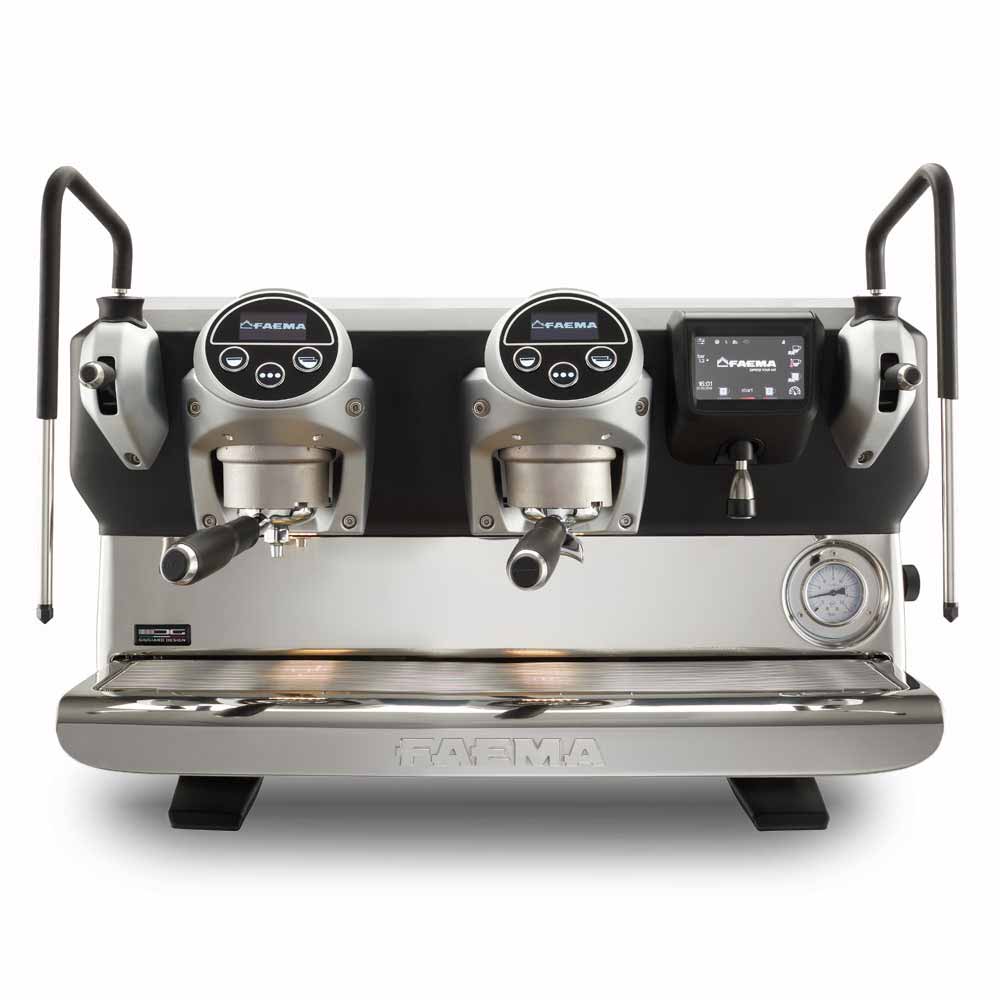
Used correctly, volumetric programming standardises the water yield per extraction so that shot-to-shot ratios remain consistent regardless of who pressed the button. On machines like the Espressa Falcon — with its 7-inch touchscreen and recipe storage per group — this extends to pre-infusion time and pressure profile, so the machine's behaviour is identical across every extraction regardless of which barista set it up that shift. On simpler volumetric machines like the Espressa ES.One, the four-button programming covers single and double dose volumes that once set, the whole team works from.
The misuse pattern is common: one barista reprogrammes the volumetric dose mid-shift to compensate for a grind drift rather than adjusting the grinder, then leaves the machine in its reprogrammed state for the next barista to inherit. Now the grinder and machine are both offset from their calibrated starting points, and the next dial-in becomes significantly harder.
Establish a clear rule: volumetric settings are set by the calibrating barista at opening and not changed during service. Grind drift is corrected at the grinder, not by reprogramming the machine's water volume. This separation of responsibilities prevents the cascading calibration drift that plagues multi-barista bars.
Step 4: Build a Weekly Team Tasting Routine
Technique standardisation alone is not sufficient. The team also needs a shared sensory reference — a common understanding of what the correct shot tastes like — so that individual taste judgements converge rather than diverge over time.
A weekly 20-minute tasting session structured as follows creates this shared reference:
-
Pull three shots from the standard recipe: one at target grind, one 1 step finer, one 1 step coarser
-
Taste all three without identifying which is which
-
Have each barista describe what they taste — balanced, sour, bitter — and identify which sample is the calibrated target
-
Discuss disagreements openly and resolve against the extraction time data
This exercise does two things simultaneously. It calibrates the team's palate to a shared standard, and it surfaces individual barista biases in taste perception — the barista who consistently prefers the slightly finer shot, or the one who does not register sourness as a problem. Understanding these preferences allows the manager to catch when a barista is unconsciously pulling shots toward their personal preference rather than the house standard.
Run this session with the same beans from the same batch used in regular service. Do it on a Monday or Tuesday when the week is fresh. Document the agreed target and post the tasting notes at the station alongside the technical parameters.
Step 5: Create a Station Reset Card That Every Shift Inherits
All of the above only works if the station is returned to its standardised state between every shift. Build a Station Reset Card — a laminated checklist affixed to the bar — that every departing barista completes before handing over.
The card should confirm:
-
Grinder setting is at the current calibrated position (note the specific setting, not "correct")
-
Volumetric dose programmed in machine matches the shift log
-
Dose target weight confirmed on scale with a verification pull recorded
-
Portafilter and baskets clean and racked
-
Cleaning steps completed per end-of-shift protocol
This card exists because verbal handovers fail. In a busy Indian café where the morning shift is leaving while the afternoon rush begins, "the grinder is at about the right setting" is not actionable information for the incoming barista. A written card with a specific step number is.
Machine Features That Make Cross-Training Easier
Some machines are structurally easier to standardise across multiple baristas than others, and this is worth factoring into equipment decisions for multi-barista setups.
For cafés evaluating the best espresso machine for a 50-seat café in India where two or three baristas share the same machine across multiple shifts, the programmed recipe architecture of the Espressa Falcon or Izensso Raptor is not a premium convenience — it is a consistency infrastructure that reduces the management burden of daily cross-shift calibration significantly.
Mistakes to Avoid: The Consistency Killer That Hides in Plain Sight
Mistake: Letting the most experienced barista be the only person who can re-calibrate the grinder.
In many Indian cafés, grinder calibration becomes the exclusive domain of the head barista or owner. Everyone else is told not to touch it. The logic is understandable — an incorrect adjustment can waste coffee and time. But the result is that when the head barista is off shift, the grinder drifts and the team compensates through technique rather than correction. Shots slow down. Baristas run longer extractions without adjusting. Quality degrades for an entire shift and no one makes the change because they are not authorised to.
The fix is documented calibration authority — a clear written protocol for grinder adjustment, with maximum correction limits (no more than 3 steps in either direction without checking with the manager), so that any trained barista can make a small grind correction when needed and knows exactly when to escalate. Empowering the team with limited, documented authority produces better consistency than centralising knowledge in one person who cannot always be present.
At Coffee.Plus, every commercial espresso machine and grinder installation includes barista training that covers dose standardisation, volumetric programming, grinder calibration authority, and the shift handover protocol your specific team needs. Whether your bar is running the Espressa ES.One for a commercial espresso machine for a small café in India, or a Ceado E7 paired with a multi-group machine for higher volume, we set up the consistency systems before we leave — not just the hardware. Pan-India technician support and AMC programs keep the equipment calibrated at the machine level between visits, so the human consistency work your team does is built on a stable technical foundation. If you want to run a multi-barista workflow simulation on actual equipment before deciding on your setup, our Experience Centre in Delhi at 14 Regency, Asola is the place to do it — with your team, your beans, and real service conditions.