


![[PRE ORDER] MHW-3BOMBER Cube Coffee Scale 3.0 Mini Pro](http://coffeeplus.in/cdn/shop/files/MHW-3BOMBERCubeCoffeeScale2.0MiniCoffeePlus5.webp?v=1768422727&width=500)

![[PRE ORDER] TIMEMORE Black Mirror Basic 3.0](http://coffeeplus.in/cdn/shop/files/TIMEMOREBlackMirrorBasic3.0_1.webp?v=1769444750&width=500)


![[PRE ORDER] MHW-3BOMBER Cube Coffee Scale 3.0 Pro](http://coffeeplus.in/cdn/shop/files/MHW-3BOMBERCubeCoffeeScale3.0Pro2.webp?v=1777319705&width=500)


![[PRE ORDER] Espressa Orbit 64 PRO | MOKKOM Grinder](http://coffeeplus.in/cdn/shop/files/Espressa_Orbit_Pro_2.webp?v=1779828190&width=500)


![[PRE ORDER] MHW-3BOMBER X-Press58](http://coffeeplus.in/cdn/shop/files/X-press58.webp?v=1763141665&width=500)


![[PRE ORDER] MHW-3BOMBER Cyclone Needle Distribution Tool 58mm](http://coffeeplus.in/cdn/shop/files/CycloneNeedleDistributor.webp?v=1762881161&width=500)




The Pre-Service Checklist Every Commercial Barista Should Run Before Opening: A 20-Minute Protocol for Indian Cafés (2026)
Most shot quality problems during a café service trace back to skipped or rushed opening procedures — not equipment failure, not bad beans, and not barista technique. A structured 20-minute pre-service protocol is the single most high-leverage habit a commercial bar team can build. Run it consistently, and your first drink of the day will taste the same as your fiftieth.
A Bengaluru specialty café had been getting inconsistent reviews for morning service. Afternoons were solid — drinks were consistent, customers were happy, and the bar was running well. Mornings were unpredictable: sour shots, thin crema, occasional bitter finishes with no obvious cause. The machine was the same. The beans were the same. The afternoon barista and the morning barista were even the same person on most days. The problem turned out to be entirely procedural. In the morning, the machine was turned on 8 minutes before service and the first 12 drinks were pulled on a group head still 4°C below target temperature. In the afternoon, the machine had been running for hours and was fully stable. The fix was not a new machine. It was a 20-minute pre-service protocol that the morning barista had never been given.
Why the First 20 Minutes Determine the Quality of the Entire Service
A commercial espresso machine is a precision thermal system. Water temperature at the group head, steam boiler pressure, and the grinder's burr temperature all affect extraction quality — and none of them are at operating equilibrium the moment you flip the power switch.
The pre-service window is when you bring every variable in the system to its working state before a single paying customer places an order. Skipping it does not save time. It costs you the first 30–40 drinks of the day in quality variance and the customer confidence that goes with them.
The protocol below takes 20 minutes when done properly. It is non-negotiable.
Step 1: Machine Power-On and Warm-Up Verification (Minutes 0–15)
The first thing you do when you arrive is turn on the machine. Not make yourself a coffee. Not check the till. Turn on the machine, because warm-up time is fixed and cannot be rushed regardless of anything else that needs doing.
Warm-up time by machine architecture:
A single-boiler machine like the Espressa Base requires a full 20–25 minute warm-up before the group head is at stable brewing temperature. A thermosyphon machine like the Espressa ES.One reaches its working state in 15–20 minutes, but the group head benefits from a group flush before the first extraction to clear residual cool water from the dispersion system. Multi-boiler machines — like the Izensso Raptor with its T3 multi-boiler architecture or the Espressa Falcon with its thermomatic heating system — reach operating temperature faster, often within 10–12 minutes, because the brew boiler and steam boiler manage their temperatures independently and do not wait on each other to stabilise.
How to verify the machine is actually ready — not just warm:
Do not rely on the power-on time alone. Use one of these methods:
-
On machines with a temperature display or touchscreen (Espressa Falcon, Izensso Raptor), confirm the PID reading for the brew boiler is at the set point and has been stable for at least 3 minutes
-
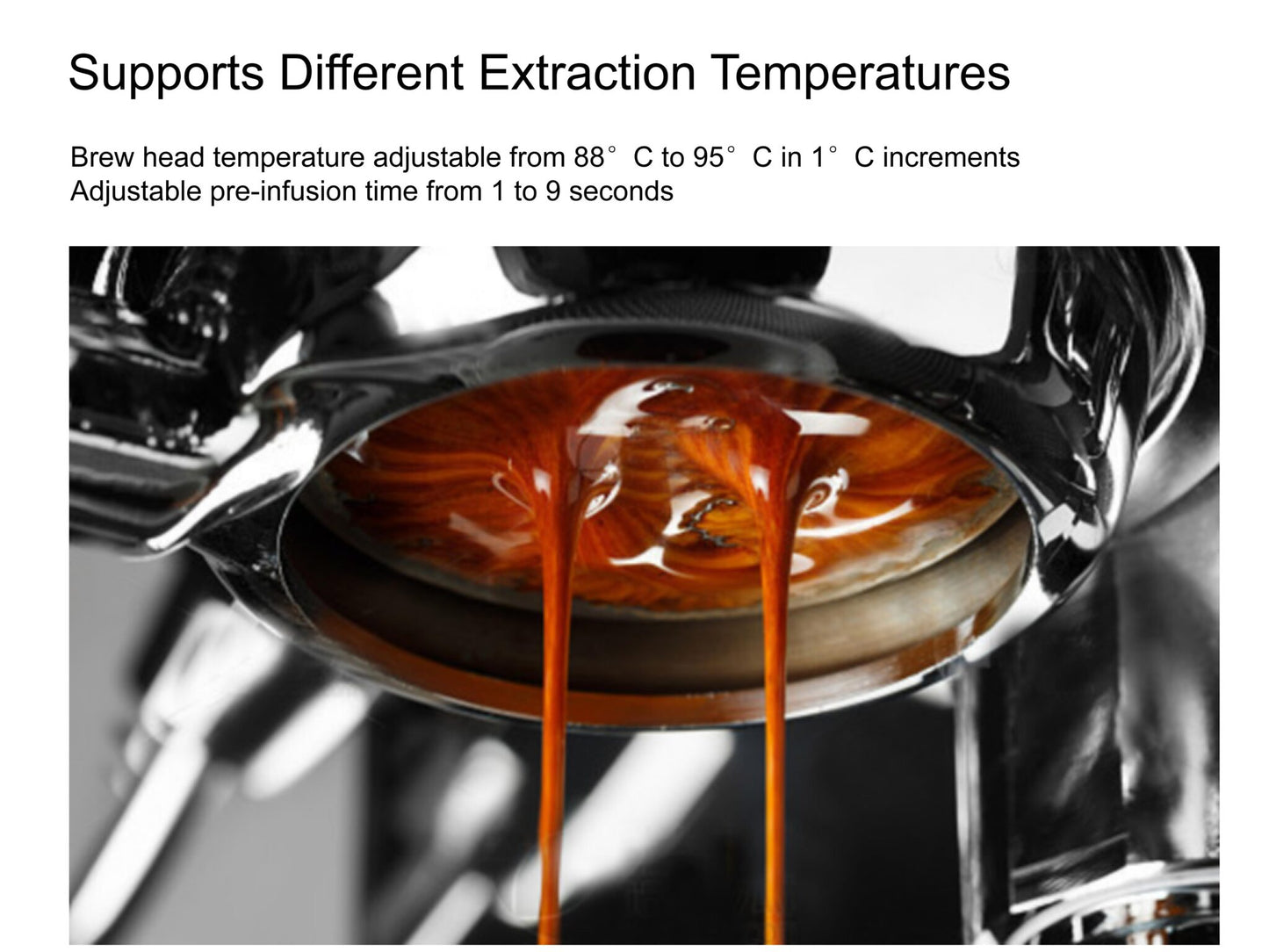
On machines without a display, run a blank shot — water only through the group with no portafilter — and check that the water temperature feels consistent and hot when briefly contacted on the back of your hand or measured with a probe thermometer. Cold or warm-but-not-hot water means the group head is still climbing
Until the machine shows a stable temperature at the group head, every espresso you pull is brewed at a temperature below target. On a 1:2 extraction ratio, a 4°C drop in brew temperature produces a noticeably lighter, more sour cup — the kind of morning complaint that café teams usually attribute to "the machine not working well" rather than inadequate warm-up.
Step 2: Portafilter Seasoning and Group Head Flush (Minutes 12–15)
Once the machine is at temperature, lock the portafilter into the group head and leave it for 2–3 minutes before pulling the first shot. The portafilter is a heavy metal component — it absorbs and retains heat when locked in, and a cold portafilter sitting out overnight drops the brew water temperature by 2–4°C on contact, even when the group head itself is stable.
After the portafilter has been warming in the group, run a group flush — a 5-second water purge through the group with the portafilter removed. This clears any stale water sitting in the group head dispersion block from overnight and confirms that water flow from the pump is clean and unobstructed. Follow this with a quick wipe of the shower screen and group head gasket with a clean damp cloth.
Now load your first dose and pull a seasoning shot — a calibration pull that you observe carefully and discard. This shot serves two purposes: it confirms the grind setting is correct, and it further seasons the group head and portafilter with coffee oils before service begins.
A seasoning shot that extracts in 25–30 seconds at your target dose and yield is your green light. One that runs fast (under 22 seconds) or slow (over 35 seconds) tells you the grinder needs adjustment before service opens.
Step 3: Grinder Check and Calibration Confirmation (Minutes 13–17)
The grinder is where most pre-service failures originate — not the machine. Coffee absorbs ambient humidity overnight. Beans left in a warm, humid Indian kitchen between close and open will have softened slightly compared to their state during yesterday's dial-in, particularly through the monsoon season and in coastal cities like Chennai or Kochi. Softer beans grind finer at the same setting, which slows extraction and produces over-extracted, bitter shots on a setting that was perfect at service close the night before.
Run your seasoning shot timed against your target extraction window. If it is running 3 or more seconds outside the target, adjust the grinder — finer if the shot is too fast, coarser if it is too slow — and pull a second verification shot. The Ceado E7's Steady Lock Grinder system holds the calibrated position overnight reliably, which means recalibration in the morning is usually a fine-tune rather than a full reset. A grinder without a locking mechanism may require more significant adjustment after an overnight gap, particularly after high-humidity nights.
On Espressa Firenze grinders paired with mid-commercial setups, the stepless adjustment allows precise incremental correction — a quality that matters in the morning calibration window when you need to correct drift without overshooting the setting. Do not open for service until the seasoning shot is extracting within your target window. The two minutes this takes protects the quality of every drink that follows.
Step 4: Steam Wand Check and Milk Station Setup (Minutes 15–18)
Purge the steam wand before touching any milk. A 3-second steam burst clears condensed water that collects inside the wand overnight — water that will dilute and cool the first pitcher of milk if it is not purged first. Wipe the wand after purging with a clean, damp cloth.
Check the steam tip for blockages from overnight milk residue. If the steam tip is blocked, clear it now with a fine pin, then purge again. A blocked steam tip does not just create weak steam pressure — it creates uneven steam distribution inside the milk pitcher, producing poor texture even when technique is correct.
Stage your milk supply: bring cold milk to the bar station and ensure your pitchers are at ambient temperature or cooler before the first order. Room temperature or pre-warmed pitchers change the start-to-finish steaming time and affect the texture quality of the final milk — this is a detail that becomes invisible during a rushed setup and surfaces as inconsistent latte art or thin microfoam.
Step 5: The Test Drink — Your Quality Gate Before the First Customer (Minutes 18–20)
Before opening service, make one complete test drink — your bar's most popular milk-based order. Pull the shot, steam the milk, pour the drink, and taste it.
This is your quality gate. It is not a warm-up drink for yourself. It is the final checkpoint that confirms machine temperature, grind calibration, steaming quality, and workflow timing are all correct simultaneously.
What to check in the test drink:
-
Shot flavour: balanced, neither sour (under-extracted) nor bitter (over-extracted)
-
Crema: present, consistent colour, not dissipating immediately
-
Milk texture: smooth, glossy, no large bubbles, correct temperature (60–65°C)
-
Workflow timing: the complete drink cycle from dose to pass should match your target time
If the test drink passes, you are ready to open. If any element fails, identify and correct the specific variable — grind, temperature, steam — before accepting the first order. Opening five minutes late on a quality confirmation is a better business decision than serving thirty mediocre drinks because the protocol was skipped to open on time.
The Complete Pre-Service Checklist at a Glance
Mistakes to Avoid: The Opening Shortcut That Costs the Most
Skipping the seasoning shot and opening immediately on the first extraction.
This is the most common pre-service mistake in Indian café operations and it is almost entirely invisible to the operator because the first few customers rarely complain directly — they just do not return. The first extraction on a freshly warmed group head, even after correct warm-up time, pulls through residual overnight water in the group and distributes it unevenly into the puck. The resulting shot is typically weaker and more sour than a seasoned group would produce. Taking 45 seconds to pull and discard one shot before service opens protects every drink that follows it.
Building this protocol into a laminated checklist posted at the machine — not in a training manual that no one opens — is the implementation that actually sticks, especially in Indian cafés with high staff turnover. When the procedure is on the machine, it transfers to the next barista automatically. When it lives in someone's memory, it leaves when they do.
At Coffee.Plus, barista training included with every commercial machine installation covers this exact pre-service protocol calibrated to the specific machine your team is operating. Whether your bar is running an Espressa Base on its first commercial setup or an Izensso Raptor at mid-commercial volume, we train your team on the warm-up windows, grinder dial-in workflow, and quality gate procedure specific to that machine's architecture before the first service day. Pan-India technician support means your team always has a reference point if something in the opening routine produces an unexpected result. And if you would like to run through this protocol on the actual machine before your purchase decision, our Experience Centre in Delhi at 14 Regency, Asola is set up exactly for that — bring your team, run a full pre-service workflow, and open your café's first day already knowing the procedure cold.