


![[PRE ORDER] MHW-3BOMBER Cube Coffee Scale 3.0 Mini Pro](http://coffeeplus.in/cdn/shop/files/MHW-3BOMBERCubeCoffeeScale2.0MiniCoffeePlus5.webp?v=1768422727&width=500)
![[PRE ORDER] TIMEMORE Black Mirror Basic 3.0](http://coffeeplus.in/cdn/shop/files/TIMEMOREBlackMirrorBasic3.0_1.webp?v=1769444750&width=500)


![[PRE ORDER] MHW-3BOMBER Cube Coffee Scale 3.0 Pro](http://coffeeplus.in/cdn/shop/files/MHW-3BOMBERCubeCoffeeScale3.0Pro2.webp?v=1777319705&width=500)


![[PRE ORDER] Espressa Orbit 64 PRO | MOKKOM Grinder](http://coffeeplus.in/cdn/shop/files/Espressa_Orbit_Pro_2.webp?v=1779828190&width=500)


![[PRE ORDER] MHW-3BOMBER X-Press58](http://coffeeplus.in/cdn/shop/files/X-press58.webp?v=1763141665&width=500)


![[PRE ORDER] MHW-3BOMBER Cyclone Needle Distribution Tool 58mm](http://coffeeplus.in/cdn/shop/files/CycloneNeedleDistributor.webp?v=1762881161&width=500)




What to Check Before Buying a Commercial Coffee Grinder for Your Café in India: Eureka, Ceado & Dalla Corte Buying Guide (2026)
Quick Take: Burr size, motor power, and heat management determine whether a grinder can handle commercial volume without degrading shot quality mid-service. Price and appearance are not on that list. Evaluate grinders the way a technician would — on the specs that affect what ends up in the portafilter, not on what the product page leads with.
A Chennai café owner selected a well-reviewed grinder based on brand recognition and price point. Within four months at 80 cups a day, shots were running inconsistently across the afternoon service — not because anything had broken, but because the grinder's motor was generating enough heat during sustained use to slightly expand the burr gap, shifting the grind finer and slowing extraction without the barista touching a setting. The machine, the beans, and the workflow were all unchanged. The grinder was simply not built for the volume being asked of it. Choosing a commercial coffee grinder for a café requires evaluating specifications that most product pages bury in footnotes. This guide lays them out clearly — so you buy once and correctly.
Why the Wrong Grinder Ruins Your Entire Setup
A mismatched grinder does not announce itself immediately. It degrades quality gradually — through thermal drift, inconsistent particle distribution, or dose variation — in ways that are easy to misattribute to beans, water, or machine calibration. By the time the grinder is identified as the problem, weeks of inconsistent service have already passed.
The commercial standard is clear: the grinder must hold particle size consistency across the full daily volume your café runs, including the peak window. Everything upstream of the portafilter — machine quality, water filtration, dialling in — is limited by what the grinder delivers.
Flat Burr vs Conical Burr: What Actually Changes in the Cup

This is the first decision, and it affects flavour profile as much as workflow.
Flat burrs cut coffee particles between two parallel rotating discs. They produce a narrower particle size distribution — more uniform grinds — which results in clarity, brightness, and definition in the cup. Light roasts and single-origin espresso benefit from flat burr precision because the extraction is consistent enough to reflect the bean's character accurately. Most commercial espresso grinders use flat burrs.

Conical burrs use a cone-shaped inner burr rotating inside a ring burr. They produce a slightly broader distribution — a mix of fine and coarser particles — which tends to create a fuller, rounder, more forgiving cup. They run cooler, retain less coffee between doses, and are less sensitive to minor calibration errors. For cafés running darker blends and milk-heavy menus where extraction forgiveness is more valuable than bright precision, conical burrs are a legitimate commercial choice.
The commercial summary: flat burrs for precision and light roast clarity; conical burrs for blend-forward menus and forgiving high-volume operation.
Burr Diameter: Why Size Determines Volume Capacity
This is the specification most buyers overlook entirely.
Burr diameter determines how much coffee surface is in contact with the cutting edge at any given moment — and therefore how fast the grinder can process a dose without generating excessive heat. Larger burrs grind faster, run cooler, and last longer at high volume.
The Eureka Mignon Specialita runs 54mm flat burrs — appropriate for boutique cafés and kiosks at light-to-mid commercial volume. Its Silent Technology keeps noise low enough for open-plan café environments, and stepless micrometric adjustment allows precise grind changes without locking to fixed steps. The ACE system reduces static and grounds retention. For a small commercial café in India where volume is under 70 cups and precision matters, this is a grounded choice.
The DF64 — with its 64mm flat burrs, single-dose workflow design, and near-zero retention — is the right option for cafés running specialty single-origin menus where every dose needs to be ground fresh without residual carry-over from the previous batch. It is not a high-throughput machine, but for quality-first specialty bars at moderate volume, the dose-by-dose precision it delivers is difficult to match at the price point.
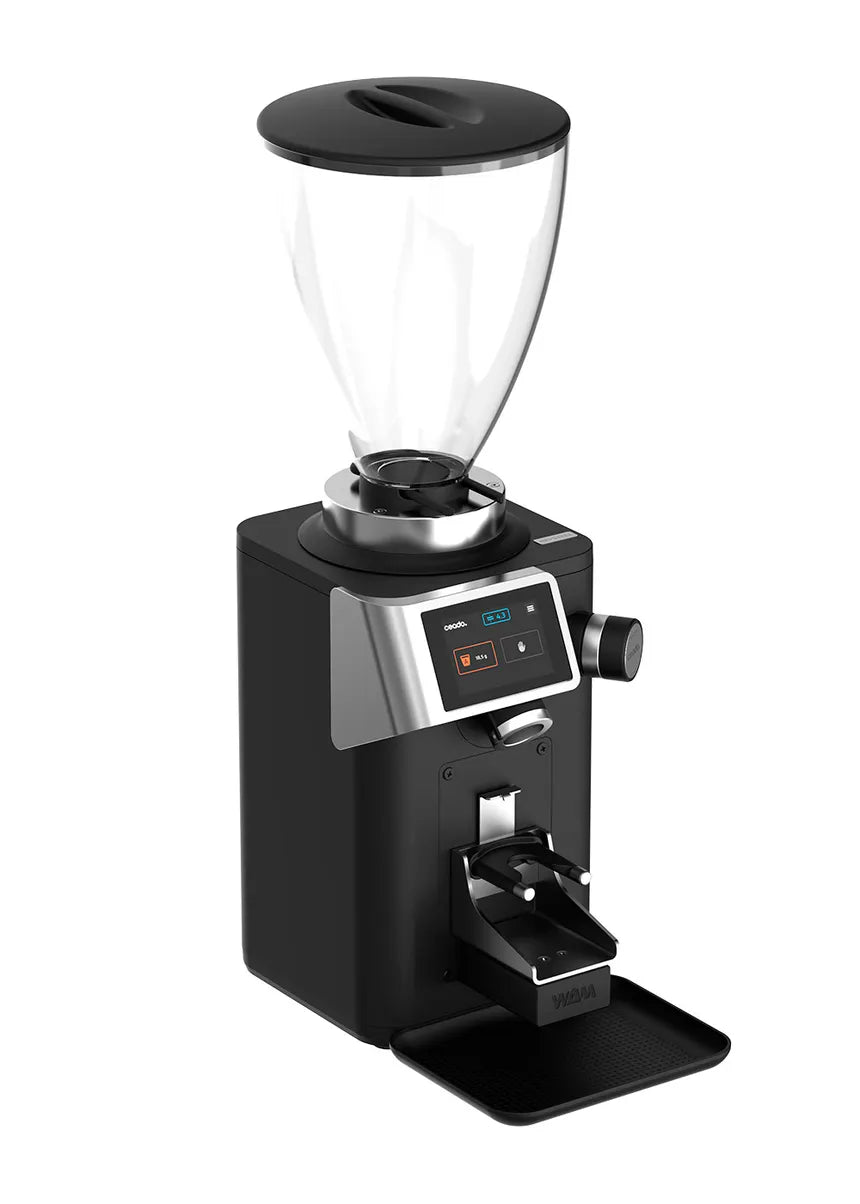
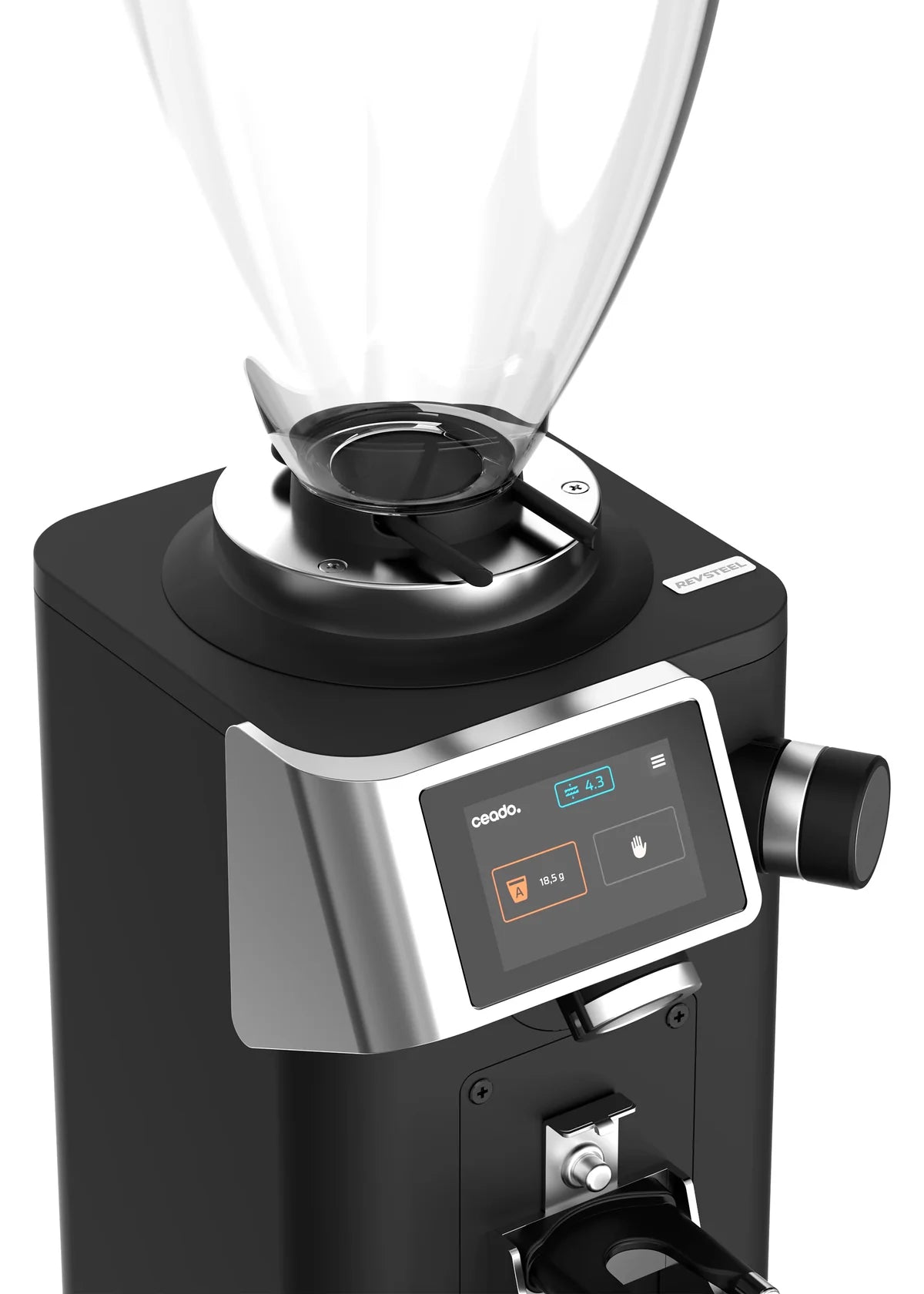
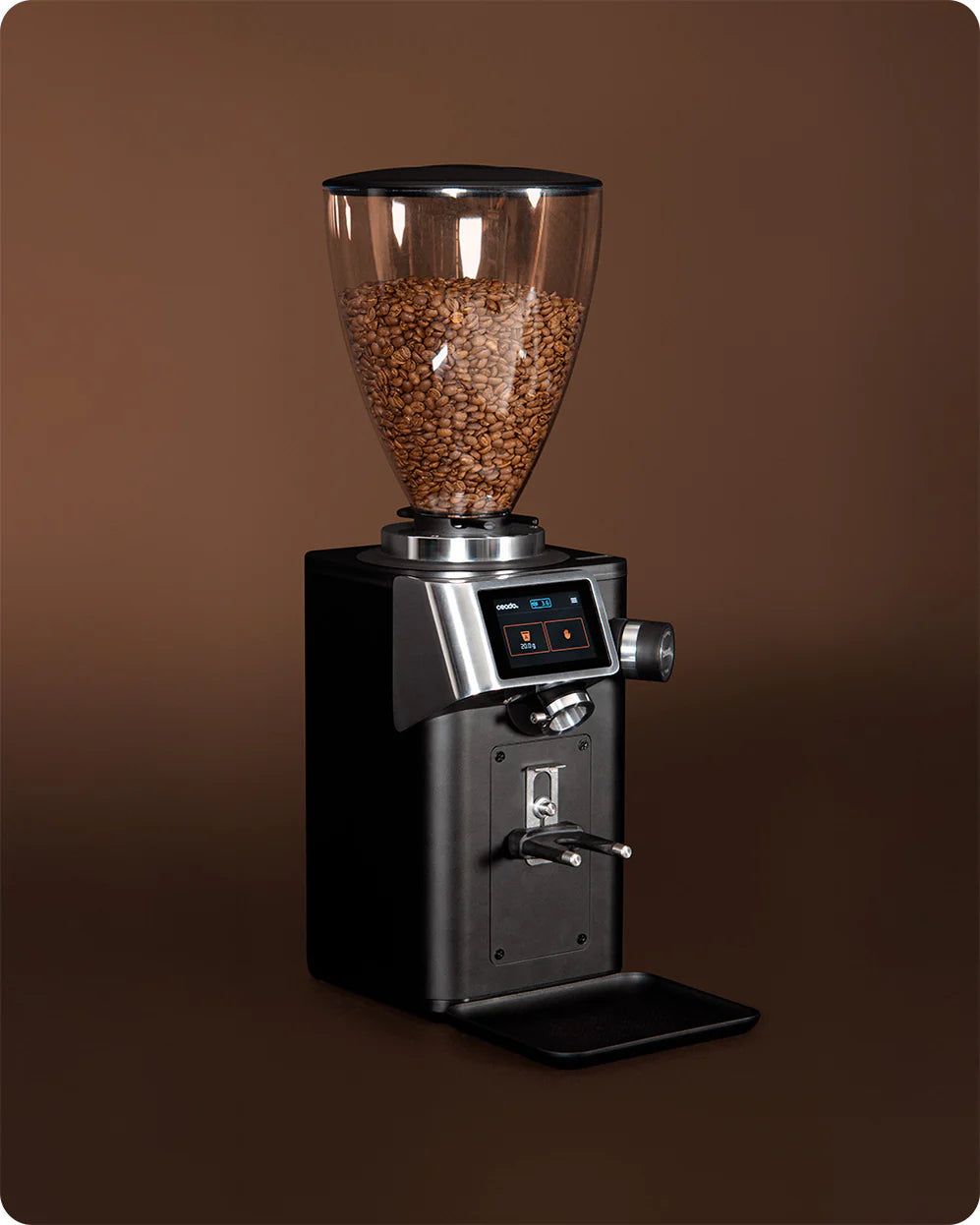
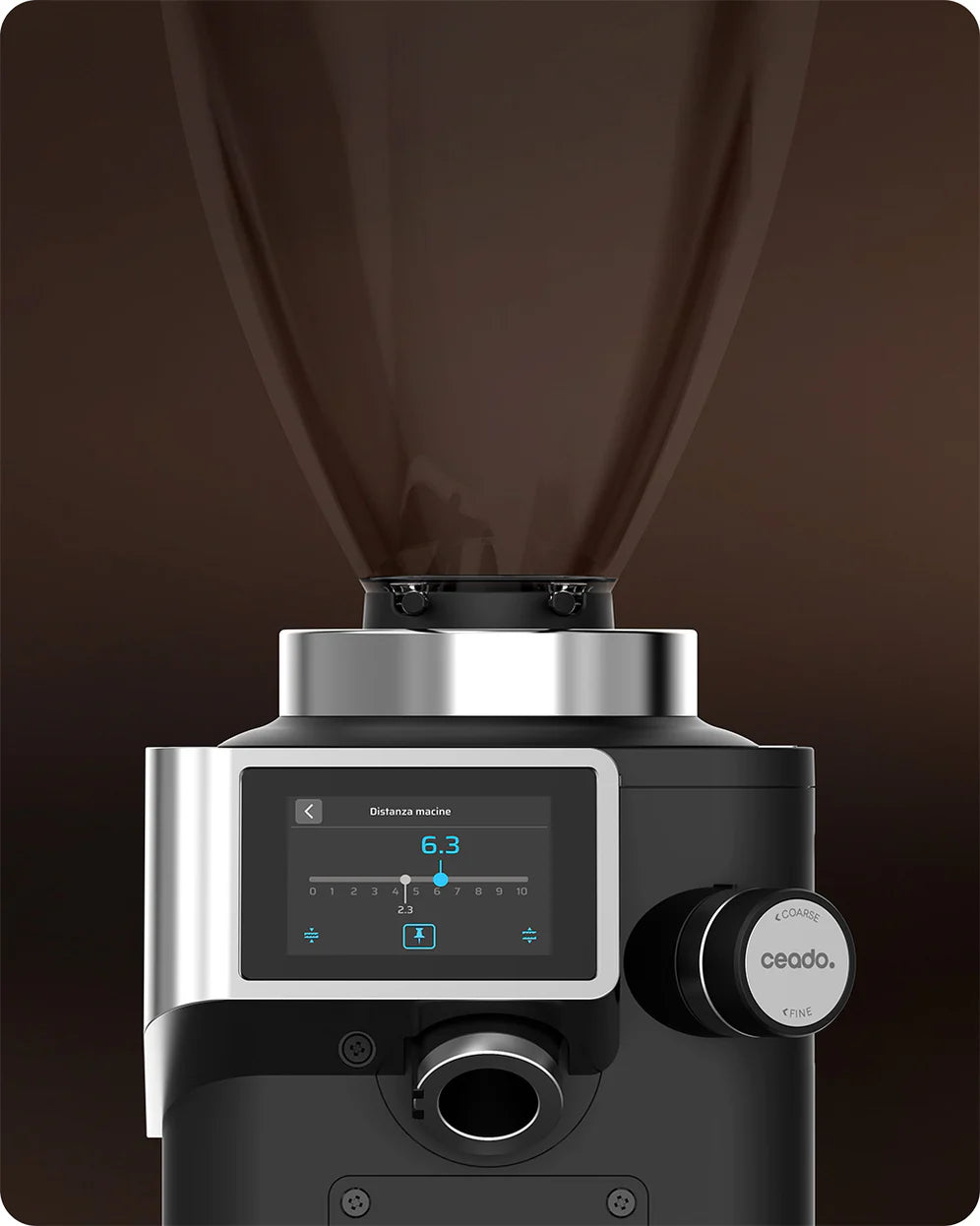
The Ceado E7 runs 64mm flat burrs in a full commercial body designed for sustained back-to-back grinding. Its Steady Lock Grinder system holds burr alignment under sustained load — preventing the micro-drift that cheaper grinders experience during peak service. Weight-based dosing eliminates volume-based variation, ensuring every portafilter receives the same dose regardless of bean density or roast level. For cafés between 60 and 120 cups per day, the Ceado E7 is the professional standard.
The Ceado REV Steel scales this up to 83mm flat burrs with zero retention and full commercial throughput. At this level, the grinder handles 150+ cups per day without thermal compromise and pairs directly with a 2-group or 3-group commercial machine running at capacity.

The Dalla Corte grinder range brings Italian-engineered precision to the premium commercial tier — with burr geometry and motor spec calibrated for use alongside Dalla Corte's extraction platforms, where grind quality and machine capability are expected to match at the highest level.
Motor Power and Heat Management: The Real Durability Test
Motor power determines how long the grinder can run without needing rest. A grinder with an underpowered motor heats up quickly under sustained commercial load. As the motor and burrs warm, the burr gap expands slightly — producing a finer effective grind without any adjustment being made. This is called thermal drift, and it is the most common cause of unexplained extraction inconsistency during a busy service window.
What to check:
-
Motor wattage: Commercial grinders for 80+ cups/day should run 300W or above
-
Thermal protection: Does the motor have a cutoff that prevents burnout, or will sustained use cause permanent damage?
-
Burr material: Steel burrs hold edge sharpness longer than aluminium variants and maintain calibration across temperature changes more reliably
Ease of Cleaning: The Spec That Affects Daily Operations
A grinder that takes 15 minutes to clean properly will not get cleaned properly in a commercial kitchen. Coffee oil rancidity in the burr chamber is one of the most consistent sources of off-flavour in cafés that otherwise have excellent equipment — and it is entirely avoidable.

Check before buying:
-
Can the upper burr carrier be removed and replaced without tools?
-
Does the grounds chamber detach cleanly for wiping?
-
Is there a manufacturer-specified cleaning tablet protocol?
Grinders with accessible burr chambers and removable grounds hoppers get cleaned. Those that require disassembly get wiped down and hoped for. In a commercial operation, the difference compounds daily.
At Coffee.Plus, every grinder recommendation is matched to the machine it will pair with, the daily volume the café targets, and the menu it needs to support. Whether you are evaluating a Eureka Mignon for a specialty kiosk, the Ceado E7 for a growing mid-volume café, or the REV Steel for a full commercial bar, we supply each unit with professional installation guidance, calibration to your roast profile, and genuine spare parts support through our pan-India service network. AMC coverage is available across the commercial grinder range — because a grinder that runs correctly through year three is worth significantly more than one that was cheap on day one.