









Why Commercial Espresso Grinders Need Different Maintenance Than Machines: A Complete Service Guide for Indian Cafés (2026)
Most café operators clean their espresso machine daily and service it every six months — and clean their grinder when they remember to. This asymmetry is one of the most consistent causes of slow extraction quality decline in Indian commercial operations. Grinders require more frequent attention than machines, different cleaning chemistry, and a professional service interval that most cafés have never established. This guide gives you the complete grinder maintenance framework that prevents the invisible quality drift that costs your café without ever announcing itself.
A specialty café in Pune had been pulling consistently excellent shots for its first eight months. Then, gradually, the espresso started tasting flatter — less sweet, less aromatic, a slight stale finish that the team noticed but could not explain. The machine had been descaled on schedule. The water filter had been replaced. New beans from the same roaster were ordered. The issue persisted. When a technician opened the grinder for the first time since installation, the burr chamber walls were coated in a layer of rancid coffee oil and fine coffee particles that had accumulated over 8 months of daily commercial use without a single deep clean. The grind particles passing through that chamber were being contaminated on every dose with oxidised oil residue. The machine was irrelevant. The grinder had been quietly degrading every shot for months.
Why Grinder Maintenance Is More Frequent and More Complex Than Machine Maintenance
Commercial espresso machines operate in a largely closed, self-cleaning thermal environment. Hot pressurised water moves through sealed passages, and the primary maintenance tasks — backflushing, descaling, gasket replacement — address predictable wear points on a defined schedule. The machine's internals are protected from open-air contamination.
A commercial grinder operates in the opposite environment. Coffee is an organic material — it contains oils, moisture, and fine particles that deposit on every surface they contact. The burr chamber, chute walls, adjustment collar, and dosing mechanism are all in constant contact with fresh and residual ground coffee. At commercial volume, this contact is sustained across 6–12 hours of daily operation.
Coffee oils extracted by the grinding process oxidise rapidly when exposed to air. On burr surfaces and chamber walls, oxidised coffee oil creates a rancid, stale residue that transfers to every subsequent dose passing through the grinder. This contamination is not neutralised by the heat of extraction — it survives into the cup as a background stale or bitter note that makes the espresso taste older than the beans actually are.
Coffee fines — the sub-100 micron particles generated in every grind — are electrostatically attracted to grinder surfaces and accumulate in angles and recesses that coarse cleaning does not reach. High fines accumulation compresses over time into a dense residue that restricts grind flow, contributes to dose inconsistency, and — in the dosing chamber of doser-style grinders — becomes a vector for stale coffee contaminating fresh doses.
The combination of oil and fines accumulation means that a commercial grinder running without structured cleaning progressively delivers staler, more inconsistent doses from month one through month twelve, with no single dramatic failure to signal the problem.
The Weekly Cleaning Protocol for Commercial Grinder Burrs
At commercial volume — 1.5kg or more of coffee per day — weekly burr cleaning is the correct interval. Not monthly. Not "when we remember." Weekly.
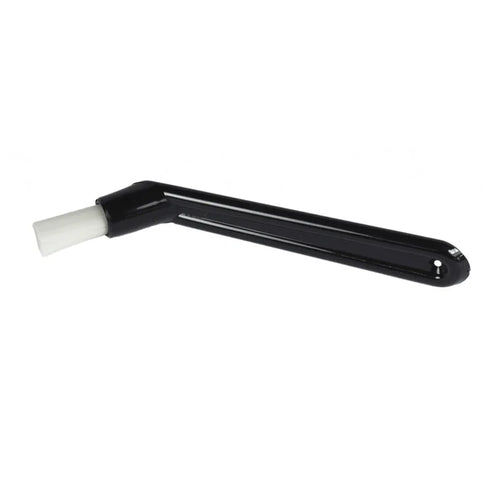
The distinction from home or low-volume use is cumulative throughput. A grinder processing 1.5kg per day runs approximately 10.5kg through the burr set each week. At that throughput, oil accumulation on the burr surfaces reaches a level that begins affecting grind particle distribution within 5–7 operating days. The Ceado E7's flat burr design — with its accessible burr removal system — makes weekly cleaning practical within the time constraints of a commercial operation. Burrs can be removed, brushed clean with a dedicated burr cleaning brush, and reinstalled in under 10 minutes by a trained team member. The cleaning brush matters: metal tools scratch burr surfaces. A food-safe nylon or natural bristle brush removes residue without affecting the burr's cutting edge geometry.
The practical protocol for weekly burr cleaning:
-
Power off and unplug the grinder completely before opening
-
Remove the upper burr following the manufacturer's removal sequence for that specific grinder
-
Brush both the upper and lower burr surfaces with a dedicated cleaning brush — focus on the channels between cutting edges
-
Wipe the burr chamber walls with a dry food-safe cloth to remove accumulated fines and oil residue
-
Inspect the shower ring or collar for compacted residue and clear if present
-
Reinstall the upper burr, confirm alignment, and run a purge dose of 5–10g to clear any cleaning debris before service resumes
On Eureka grinders with the ACE (Anti-Clump System), the distribution mechanism inside the grinding chamber benefits from weekly cleaning specifically because the anti-clump fingers collect fine residue that affects their function over time. Clean ACE components directly with a soft brush — do not use water or any liquid on burr-side components.
The Daily Cleaning Steps That Most Teams Skip
Beyond the weekly burr clean, daily cleaning habits protect the grinder between deep cleans and prevent the rapid oil accumulation that happens in high-humidity Indian kitchen environments.
Hopper cleaning: The bean hopper should be emptied, wiped clean with a dry cloth, and inspected for oil accumulation on the hopper walls and throat every 2–3 days for high-volume operations. Oils from darker roasts in particular coat the hopper walls and begin to oxidise within 48–72 hours, especially in warm Indian kitchen conditions. On the Espressa Firenze grinder and similar commercial grinders with wide hopper throats, a folded dry cloth reaches the hopper base and collar without tools. Never use water to clean the hopper while it is attached to the grinder — moisture entering the grinding chamber causes fines to compact and can corrode burr-side metal components.
Chute and dosing area cleaning: The chute — the passage between the burrs and the portafilter — accumulates compacted fines and oils every day. A narrow brush or pipe cleaner run through the chute daily dislodges this accumulation before it compresses into a sticky residue. On single-dose grinders like the DF64, the direct-to-portafilter chute design makes this particularly important: fines that accumulate in the chute drop directly into the next dose.
Exterior wipe-down: The grinder exterior, adjustment collar, and any external dosing or display surfaces should be wiped with a dry or very slightly damp cloth at close of service. Ground coffee particles that collect around the adjustment collar can migrate into the collar mechanism over time and create false friction that makes accurate grind adjustment harder.
Using Grinder Cleaning Tablets: When and How
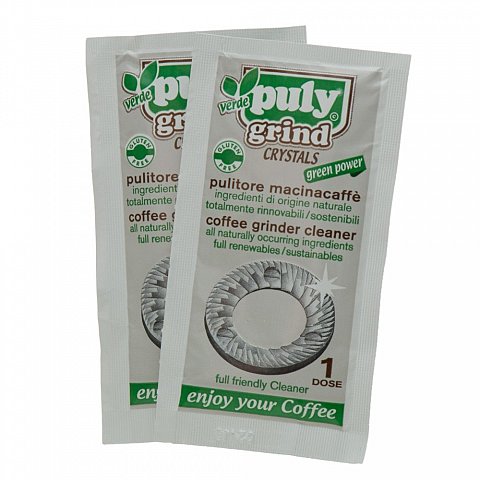
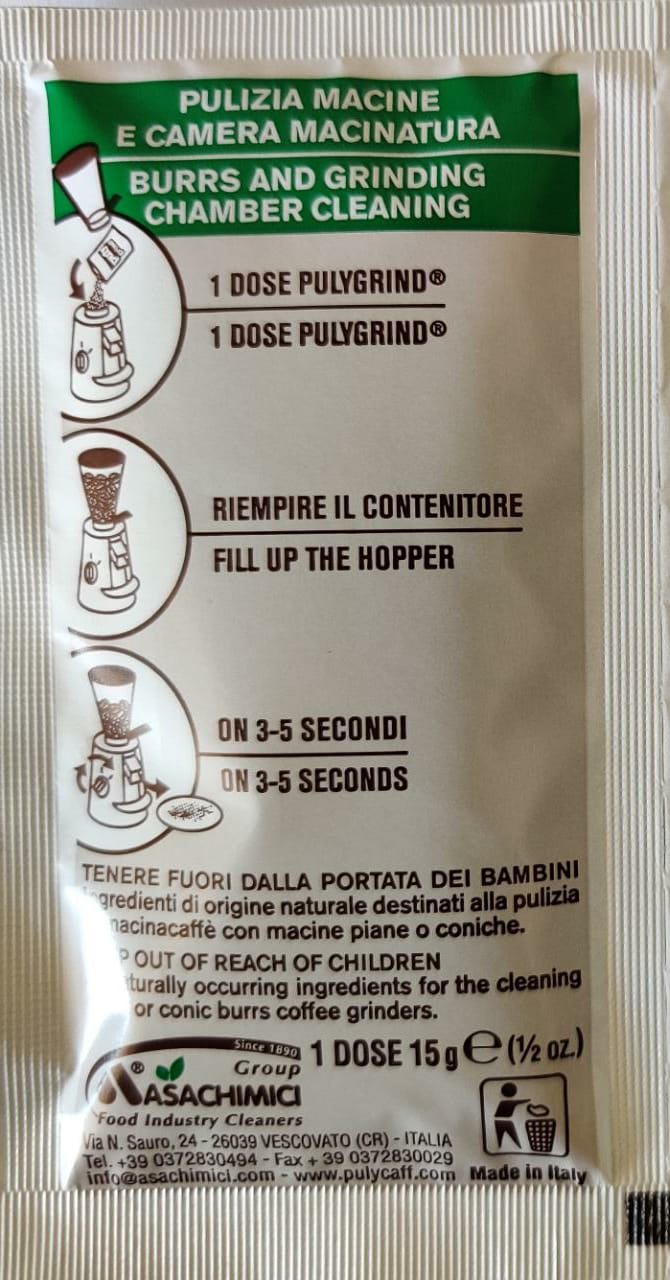
Grinder cleaning tablets — formulated products designed to be run through the grinding mechanism — are the chemical cleaning option for burr chambers that are difficult to access manually. They are not a substitute for physical burr cleaning, but they complement it in high-volume operations.
The correct use: run 30–40g of cleaning tablets through the grinder at the calibrated grind setting, followed immediately by 20–30g of coffee to purge any tablet residue before resuming service. Most commercial grinder cleaning tablets are formulated to be food-safe post-purge — confirm this for the specific product being used.
Frequency in commercial operation: Once per week for grinders running more than 2kg per day. Once per fortnight for grinders running 1–2kg per day. Not as a replacement for physical cleaning — as an addition to it. Cleaning tablets address oil accumulation in areas that brushes cannot reach inside the burr chamber, but they do not remove compacted fines that have built up in chute angles or doser mechanisms. Physical cleaning must accompany the tablet routine.
Professional Service Intervals: What Operators Cannot Do In-House
Certain grinder maintenance tasks require professional service that goes beyond what café teams can perform in-house, regardless of team skill level.
Burr alignment verification: Over time, the upper burr carrier on flat burr grinders can drift from its optimal alignment relative to the lower burr. Misalignment produces uneven particle distribution — wider on one side of the grind than the other — that creates channelling and extraction inconsistency that mimics worn burr symptoms. Alignment verification requires specific tools and expertise. This should be part of a 6-month professional service visit for high-volume commercial grinders.
Bearing inspection and replacement: The motor shaft bearings that support the burr carrier wear over several years of commercial use. Bearing wear produces a subtle change in grinding sound — a low vibration or soft oscillation that experienced technicians recognise. Unchecked, worn bearings allow the upper burr to wobble microscopically during rotation, which directly degrades particle size consistency. Bearing replacement is a professional service task.
Motor brush inspection (brush motor designs): Some commercial grinders use brush-type DC motors. The carbon brushes that conduct current to the motor armature wear over time and require inspection and replacement at commercial service intervals. This is a technician-level task.
For Ceado REV Steel grinders and commercial Dalla Corte grinders at high-volume specialty bars, the professional service interval should be every 6 months at 3kg+ per day, and annually at lower volumes. The service visit covers burr alignment, motor inspection, bearing check, chute and dosing mechanism deep clean, and grind calibration verification — tasks that collectively ensure the grinder is performing to its design specification rather than to a degraded approximation of it.
The Maintenance Calendar for Commercial Grinders in India
Mistakes to Avoid: The Cleaning Habit That Destroys Burrs Faster Than Use
Mistake: Cleaning burr grinders with compressed air and blowing out the grinding chamber.
Compressed air feels efficient — it clears visible fines quickly and takes no disassembly. What it actually does is push fines and oil residue deeper into the burr carrier housing, adjustment collar recesses, and motor bearing areas where they are impossible to remove without full disassembly. Over time, compressed-air cleaning packs residue into areas that accumulate moisture from the kitchen environment and creates compacted deposits that affect mechanical function.
The correct cleaning tool for commercial grinders is a dedicated natural or nylon bristle brush, used with the grinder powered off and partially disassembled to the burr access level. No compressed air. No water on burr-side components. No metal tools that can scratch cutting surfaces. This principle applies equally to the Ceado E7, the Espressa Firenze, and the Eureka commercial range — the cleaning method is the same regardless of burr diameter or brand.
At Coffee.Plus, every grinder supplied — whether a Ceado E7 or REV Steel with pan-India technician support, a Eureka commercial grinder for a specialty café setup, or an Espressa grinder for an entry commercial operation — comes with barista training that covers the complete grinder maintenance protocol for that specific model. AMC programs for grinders include the 6-month professional service visit as a scheduled event, not a reactive response to a problem. Genuine replacement burr sets and cleaning accessories are stocked locally — there is no waiting on import supply chains when your grinder needs a scheduled burr replacement. If you want to understand the maintenance requirements of a specific grinder model before purchasing, our Experience Centre in Delhi at 14 Regency, Asola has the equipment available to walk through the service protocol hands-on before the decision is made.