


![[PRE ORDER] MHW-3BOMBER Cube Coffee Scale 3.0 Mini Pro](http://coffeeplus.in/cdn/shop/files/MHW-3BOMBERCubeCoffeeScale2.0MiniCoffeePlus5.webp?v=1768422727&width=500)

![[PRE ORDER] TIMEMORE Black Mirror Basic 3.0](http://coffeeplus.in/cdn/shop/files/TIMEMOREBlackMirrorBasic3.0_1.webp?v=1769444750&width=500)


![[PRE ORDER] MHW-3BOMBER Cube Coffee Scale 3.0 Pro](http://coffeeplus.in/cdn/shop/files/MHW-3BOMBERCubeCoffeeScale3.0Pro2.webp?v=1777319705&width=500)


![[PRE ORDER] Espressa Orbit 64 PRO | MOKKOM Grinder](http://coffeeplus.in/cdn/shop/files/Espressa_Orbit_Pro_2.webp?v=1779828190&width=500)


![[PRE ORDER] MHW-3BOMBER X-Press58](http://coffeeplus.in/cdn/shop/files/X-press58.webp?v=1763141665&width=500)


![[PRE ORDER] MHW-3BOMBER Cyclone Needle Distribution Tool 58mm](http://coffeeplus.in/cdn/shop/files/CycloneNeedleDistributor.webp?v=1762881161&width=500)




How to Scale Your Café's Coffee Output Without Buying a New Machine: Workflow Guide for Indian Cafés (2026)
Most growing cafés have 20–30% more output locked inside their existing setup — not in the spec sheet, but in how the bar is run. Before committing to a new machine purchase, there are operational levers — grinder calibration, dose consistency, station sequencing, and workflow structure — that can meaningfully increase throughput right now. This guide identifies exactly where that capacity is hiding.
A Bangalore specialty café owner was convinced she needed a 2-group machine to handle weekend demand. Her current 1-group Espressa ES.One was pulling 65–70 cups on weekdays without strain. On Saturday, output would collapse somewhere around 90 cups. The problem was not the machine. It was a 14-second gap between each drink — the barista was tamping on the wrong side of the station, the knock box was placed behind the machine rather than beside it, and the grinder was set slightly too fine, causing 32-second extractions instead of 27. Three workflow corrections recovered approximately 18–20 cups of peak-hour capacity without touching the machine, the beans, or the budget. The machine was ready. The workflow was not.
Why Your Machine Is Probably Underperforming Right Now
Every commercial espresso machine has a rated output ceiling — but almost no café in India actually reaches it in daily operation. The gap between rated capacity and real throughput is almost always workflow-driven, not machine-driven.
The three most common capacity leaks:
-
Grinder settings drifting without recalibration — as Indian humidity shifts seasonally, particularly from March into the monsoon window, grind resistance changes measurably. Extraction times creep from 27 seconds to 33 seconds without anyone adjusting the setting. At 80 cups a day, that six-second drift costs roughly 25–30 minutes of productive bar time in a single service. Grinders with stepless micrometric adjustment — like the Eureka Mignon Specialita with its Silent Technology and ACE anti-clump system — hold calibration more precisely between humidity-driven recalibrations than stepped burr systems. If your team is recalibrating more than twice a week, the grinder mechanism is the constraint, not the barista.
-
Station layout creating cross-traffic — when the knock box, scale, and tamping mat are not arranged in a single linear motion, each drink requires the barista to turn, reach, or step sideways. Three extra seconds per drink across 100 cups is five minutes of pure dead time during your busiest hour.
-
Staff inconsistency on dose weight — a 1g dose variation between baristas changes extraction time by 3–5 seconds per drink. In a multi-person bar, this makes every drink a slightly different product and unpredictably stretches the ticket queue. Grinders like the Ceado E7 with weight-based dosing and 64mm flat burrs solve this structurally — every barista, regardless of experience level, dispenses the same gram weight every time.
None of these require a new machine. They require operational discipline and, occasionally, a grinder that is better matched to the volume being asked of it.
Understanding Your Machine's Real Output Ceiling
Before pulling any operational levers, you need an honest read on where your current machine sits in terms of throughput architecture.
Single Group Head: What Optimum Actually Looks Like
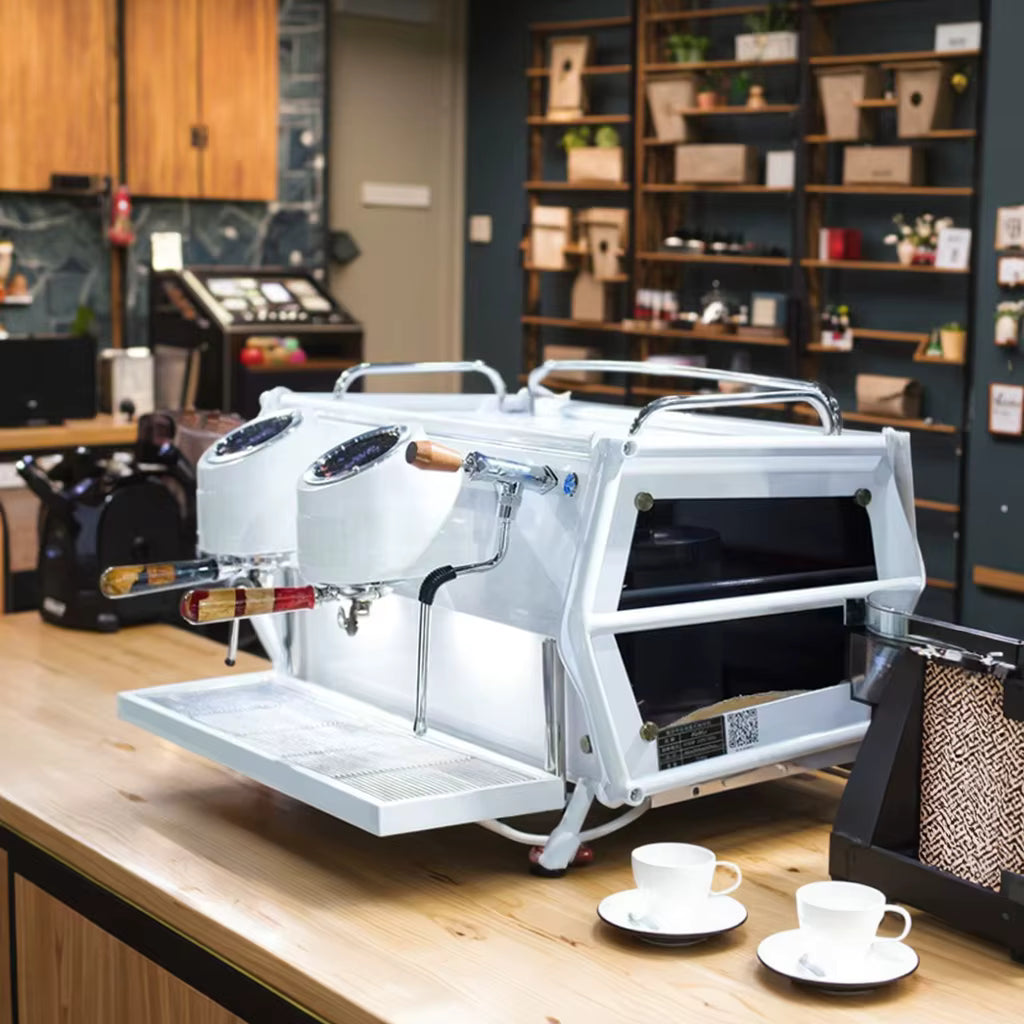
A 1-group commercial machine like the Espressa Base or Espressa ES.One has one extraction chamber. At any given moment, it can pull one double shot — approximately 25–30 seconds of active brew time. Add dose preparation (7–10 seconds), tamping (3 seconds), and locking the portafilter (2 seconds), and one barista operating a single group can realistically output one drink every 55–65 seconds when the workflow is fully optimised.
That translates to approximately 55–65 drinks per hour on a well-run 1-group machine. If your café is producing fewer than 40 drinks per hour during a rush on a 1-group setup, the ceiling has not been reached — the workflow has broken down.
The Espressa Base handles its role at entry commercial volume reliably. The throughput ceiling at this tier is almost always an operational issue, not a hardware one. The Espressa ES.One brings a fuller commercial boiler setup and improved steam recovery that sustains output across a longer service window — it is the machine that rewards good workflow with consistent results, provided the grinder feeding it is equally capable.
If your ES.One is being pushed toward its hourly ceiling daily and extraction times are still scattered, the grinder is worth checking before the machine. A grinder producing dose variance of more than 0.5g per shot creates extraction time scatter that looks like a machine problem. The Ceado E7's Steady Lock Grinder system and zero-retention design eliminate that variable entirely at mid-commercial volume.
Dual Group Head: Where the Real Throughput Leverage Lives
A 2-group machine does not simply double output — it fundamentally changes the operational model of the bar.
With two group heads — as on the Espressa Falcon or Espressa Nimbus — two workflow paths become available simultaneously:
-
Parallel operation: Two baristas working independently on separate groups, each running their own extract-steam-pass sequence without waiting on the other
-
Staggered sequential operation: One barista running both groups in an offset rhythm — starting the extraction on group two while steaming milk for the drink from group one
The staggered method is where experienced baristas extract the most output from a 2-group machine. Instead of waiting for each extraction to complete before picking up the steam wand, the barista runs groups in offset cycles so milk work fills the idle extraction time. On a well-organised 2-group bar, a single skilled barista can reach 80–100 drinks per hour.
This workflow only holds up, however, when the machine's thermal recovery between back-to-back shots is fast and consistent. A machine whose brew temperature drops after consecutive extractions forces the barista to slow down — defeating the purpose of the parallel setup entirely. The Espressa Falcon's thermomatic heating system is built precisely for this: each group maintains independent temperature stability regardless of how hard the other is being pushed. The BLDC pump holds consistent pressure during sustained peak output, and multi-stage pre-infusion recipes stored on the 7-inch touchscreen mean that switching between a house blend and a guest roast does not require a recalibration mid-service. For a café targeting the best espresso machine for a 50-seat café in India with a quality-forward dual-group workflow, the Falcon is the hardware that makes the parallel workflow reliable rather than theoretical.
When the Nimbus Enters the Picture
The Espressa Nimbus is positioned for cafés where throughput demands are no longer a question of workflow optimisation — they are a structural volume requirement. Its boiler architecture and group head design are calibrated for sustained multi-barista operation across a full service day, with back-to-back extraction capacity that does not degrade through a three-hour brunch window.
For any café consistently hitting the output ceiling of a 2-group setup — typically 120+ cups per day with regular peak-hour overflow and two baristas rotating — the Nimbus is the correct hardware upgrade consideration. Everything below that volume threshold should first go through the workflow corrections below.
The Five Operational Levers to Pull Before Buying Anything
1. Recalibrate Your Grinder Weekly During Season Changes
Build a 10-minute grinder recalibration into your weekly opening routine during seasonal transitions. Target 25–30 second extractions at your standard dose and yield. If recalibration is needed more than twice a week, the grinder's adjustment mechanism may not be designed for the climate variance Indian café environments produce. The Eureka Mignon Specialita's stepless micrometric adjustment allows fine-increment recalibration in seconds — fast enough to perform between service rushes without disrupting the bar.
2. Lock In Your Bar Layout as a Linear Flow
Left to right: grinder → knock box → tamping mat → machine → pass. Every movement the barista makes should follow this sequence without reversing direction. Sketch your current counter layout and time one full drink cycle — the dead motion will be visible immediately. A misplaced knock box alone adds 2–3 seconds per drink. Over 100 cups a day, that is recoverable time that requires no investment.
3. Standardise Dose Weight — Then Step Back from the Scale
Use a precision scale for one full service week to identify the dose variance between your baristas. Once everyone is consistently hitting the target weight, the scale can come off the production counter. The discipline built during that calibration week persists as muscle memory. Without this step, a three-person bar often runs three different effective doses across a single shift — and the machine takes the blame for inconsistency it did not cause.
4. Run Milk and Extraction in Parallel, Not in Sequence
If your barista waits for the extraction to finish before picking up the steam wand, every drink is slower than it needs to be. Start the extraction, then immediately begin steaming. The two processes finish within 5–8 seconds of each other on any machine with a responsive steam boiler. On machines like the Espressa ES.One — with a dedicated steam boiler that recovers quickly between drinks — this parallel habit is the single highest-impact workflow change a 1-group bar can make. It is worth 8–12 additional drinks per peak hour without any hardware change.
5. Use Pre-Grinding Only During Confirmed Rushes
During a high-demand window, pre-grinding one dose into the portafilter while the current shot is extracting reduces the per-drink cycle time by 7–9 seconds. This technique applies only in short rush windows — pre-ground coffee degasses within 60 seconds, so using it as a standard workflow habit degrades extraction quality over time. Applied precisely during a Saturday morning rush, it recovers real capacity. Used carelessly across a full service, it quietly undermines the quality the machine is capable of producing.
When a Machine Upgrade Is Actually the Right Call
At Coffee.Plus, every upgrade conversation starts with a workflow audit — not a product recommendation. If your current machine has untapped capacity, we will tell you that before discussing any hardware change. When an upgrade is genuinely justified, every Espressa commercial machine we supply comes with professional installation guidance, full calibration to your specific water profile and roast, barista training for your team, and pan-India technician support. AMC programs and genuine spare parts coverage mean the machine you invest in is protected for its full working life — not just the opening season.