





![[PRE ORDER] MUVNA Wooden Countertop Mat](http://coffeeplus.in/cdn/shop/files/MUVNAWoodEspressoTampingCoffeePlus1.jpg?v=1786650294&width=500)



Your Espresso Machine Is Only as Good as Your Grinder: Ceado, Espressa & DF64 Pairing Guide for Cafés in India (2026)
Quick Take: A premium espresso machine paired with the wrong grinder produces inconsistent, unprofitable shots. Grind particle size and distribution determine extraction quality more than any other variable. Match the grinder to your machine tier and daily volume — not your budget leftover after buying the machine.
A Bengaluru specialty café invested in a high-specification dual boiler machine and watched shot quality plateau. The machine was dialled in correctly. The water was filtered. The beans were exceptional. The grinder — a mid-range unit carried over from the previous setup — was producing a particle distribution too uneven for the extraction precision the machine was now capable of. Every premium component upstream was being limited by one piece of equipment downstream. Your espresso machine is only as good as your grinder. This guide explains why, and maps the right grinder choice to the machine tier and daily volume your café actually operates at.
Why the Grinder Controls What Goes Into the Cup
The espresso machine applies pressure and temperature. The grinder controls the surface area that pressure and temperature work on. A 20g dose ground inconsistently — with a mix of fine powder and coarse particles — will over-extract the fines and under-extract the coarser pieces simultaneously. The result is a shot that is simultaneously bitter and sour, with no clarity regardless of how well the machine itself is calibrated.
Grind consistency is not a refinement. It is the foundation of extraction quality. Every other variable — pressure profiling, pre-infusion, PID temperature control — only delivers its intended result when the grind entering the portafilter is uniform.
How Machine Tier Determines Grinder Requirement
Different machine levels expose grinder limitations differently:
-
Entry-level commercial machines are more forgiving of slight grind inconsistency because they operate at fixed pressure with limited extraction control
-
Dual boiler machines with PID control — like the Lelit Bianca or Espressa Alpha H6 — amplify grind quality. The precision they offer is fully realised only when the grind is equally precise. A weak grinder on a strong machine is a direct waste of the machine's capability
-
Pressure-profiling machines are the most demanding. Multi-stage pre-infusion and variable flow only produce their intended flavour result when particle distribution is tight enough that the profiling curve interacts with the puck predictably
Matching Grinder to Volume and Machine: The Right Pairing
Light Commercial: 30–60 Cups/Day
At this volume, the priority is precision over throughput. The DF64 — with its 64mm flat burrs, near-zero retention design, and extensive burr upgrade options — delivers single-dose accuracy at a price point accessible to boutique cafés and specialty kiosks. It pairs directly with entry to mid-tier commercial machines where grind-by-weight workflow is preferred and speed is secondary to quality.
For cafés at this volume running a more premium machine, the Espressa Ion grinder — Coffee.Plus's in-house grinder line — is purpose-matched to the Espressa machine ecosystem and calibrated for the extraction profiles the Alpha H6 and ES.One are designed to produce.
Mid-Commercial: 60–120 Cups/Day
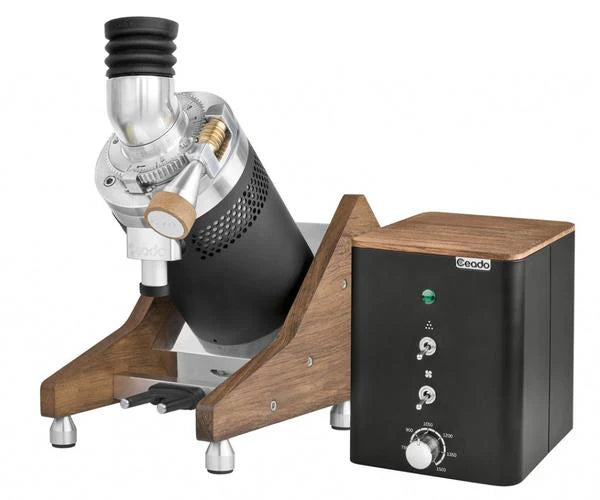
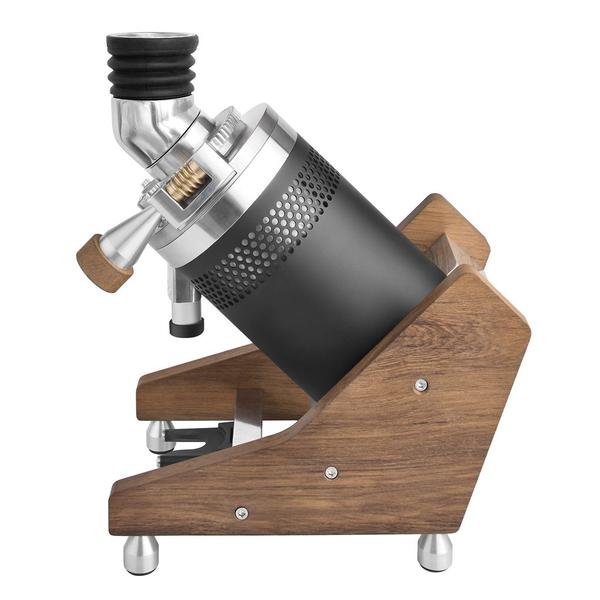
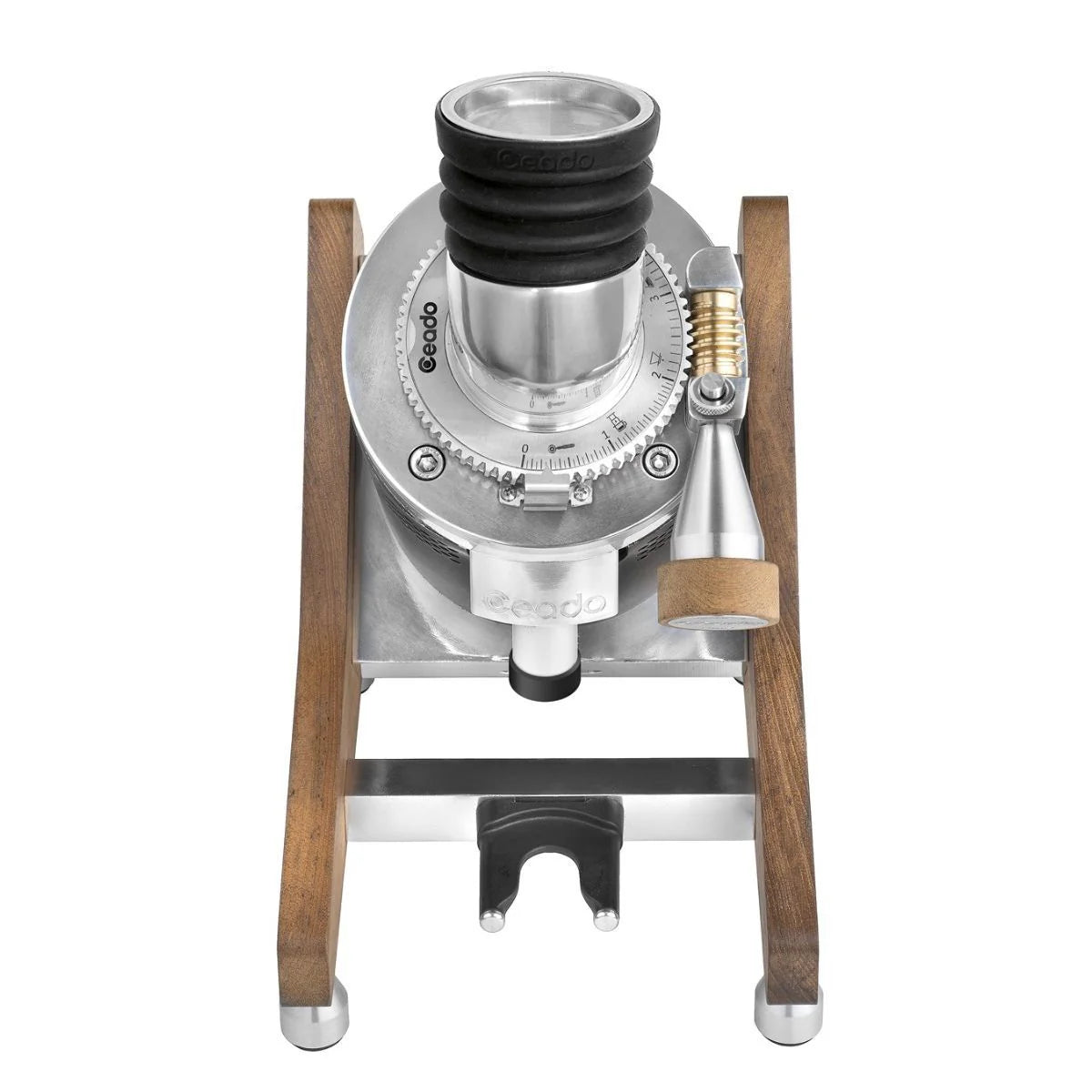
Speed and accuracy must coexist at this level. The Ceado E7 is the right unit here — 64mm flat burrs, on-demand dosing, and a motor built for sustained commercial load across a full service day. It handles the thermal stress of back-to-back grinding without the burr temperature creep that degrades shot consistency during peak windows. Pairs directly with 1-group and 2-group commercial machines including the Espressa ES.One and Lelit commercial range.
High-Volume Commercial: 120–200+ Cups/Day
At this volume, burr diameter becomes critical. The Ceado REV Steel — running 83mm flat burrs with the Steady Lock Grinder system and weight-based dosing — is built for continuous high-throughput service. Larger burrs grind the same dose with less heat per gram of coffee, which directly prevents the "cooked" taste that emerges when smaller burrs overheat during a morning rush. This is the grinder that matches a fully commercial 2-group or 3-group machine running at capacity. For hotel breakfast counters and high-volume restaurant bars, zero retention between doses is also operationally important — the Ceado REV Steel addresses this precisely.
What Most Buyers Get Wrong
The budget is spent on the machine, and the grinder is chosen from whatever is left. This is the most expensive mistake in café equipment planning. A ₹4 lakh machine with a ₹15,000 grinder will never produce ₹4 lakh results. The grinder sets the ceiling on what the machine can achieve.
Size your grinder budget to at least 40–50% of your machine budget. If that number feels uncomfortable, it means the machine may be oversized for the current stage of the business — which is also a useful decision to surface early.
At Coffee.Plus, grinder and machine pairings are part of every equipment consultation — not an afterthought. Whether you are evaluating the DF64 for a single-origin kiosk, the Ceado E7 for a mid-volume café, or the REV Steel for a high-capacity bar, every recommendation is matched to your actual cup count, menu structure, and machine specification. Every grinder we supply comes with installation guidance, calibration to your roast profile, and genuine spare parts support through our pan-India service network. AMC coverage is available across the commercial range, ensuring your grinder performs at the level your machine demands — every service, every day.